
How to Read a Solar Quote in Malaysia: Line by Line
A practical walkthrough of Malaysian solar quotes — what each line means, what's usually included, hidden extras, and how to compare proposals fairly.
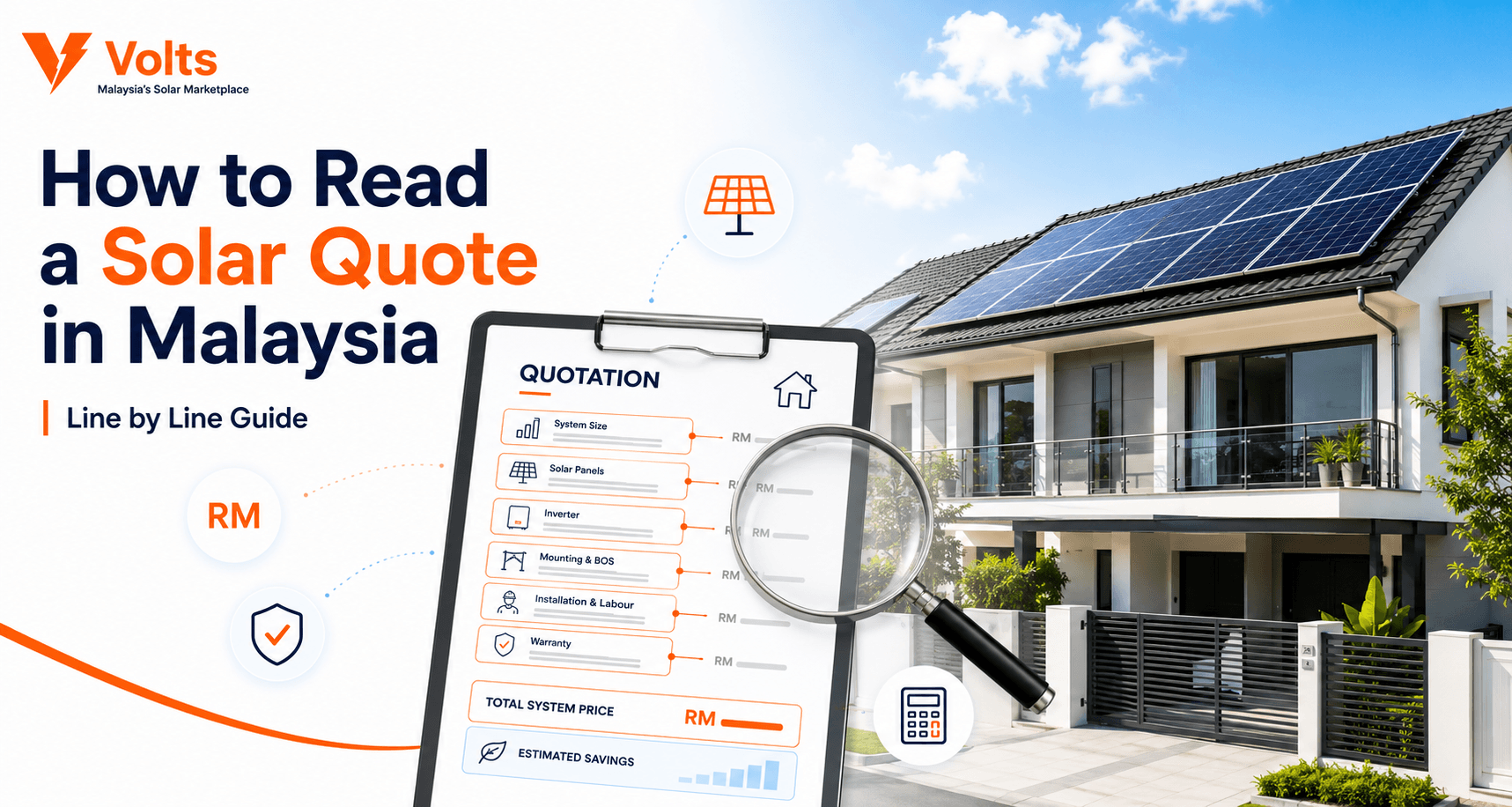
You have three PDFs on your phone and no idea why one says RM 22,000 and another says RM 38,000 for what sounds like the same system. That gap is usually not a scam — it is scope, equipment tier, and roof complexity expressed in different formats.
Key takeaway: A fair quote comparison requires the same system size (kW), the same equipment tier, and a clear list of inclusions. Normalise every proposal to price per kW and check whether TNB application fees, meter upgrade, and after-sales support are included or extra.
This guide walks through a typical Malaysian residential solar quote section by section.
Before you open the PDF: gather your baseline
Have these ready:
- Last 3–6 months of TNB bills (kWh usage, not just the total ringgit).
- Roof photos from multiple angles.
- Your target system size — use the Volts calculator for a starting estimate.
- Your address and property type — terrace, semi-D, bungalow, or condo.
Without a baseline, you cannot tell whether a quote is sized correctly or padded.
Section 1: System summary
Every quote should open with a clear summary block. Look for:
| Field | What to check |
|---|---|
| System size (kW) | DC capacity of the full array — e.g. 5.04 kW (12 × 420 W panels) |
| Estimated annual production (kWh) | Should be realistic for your location; 1,200–1,500 kWh per kW installed is a common range in Peninsular Malaysia |
| Panel brand and model | e.g. Jinko Tiger Neo 420 W — verify it is a real model, not a generic label |
| Panel count | Should match system size (count × wattage ÷ 1,000 = kW) |
| Inverter brand and model | e.g. Huawei SUN2000-5KTL or SMA Sunny Boy — note the exact model |
| Inverter capacity (kW) | Should closely match array size (slight undersizing is normal; large oversizing is a red flag) |
Red flag: mismatched numbers
If a quote says "5 kW system" but lists 8 panels at 550 W (4.4 kW), the headline number is wrong. Always calculate it yourself: panel count × panel wattage ÷ 1,000.
Section 2: Price breakdown
Malaysian quotes vary in format, but a transparent one separates these cost areas:
Equipment supply
- Solar panels
- Inverter(s)
- Mounting rails and clamps
- DC and AC cabling, connectors, breakers
- Monitoring device or app access
Installation and commissioning
- Roof mounting and waterproofing
- DC/AC wiring to distribution board
- Testing and commissioning
- Handover documentation
Regulatory and utility
- SEDA/NEM or relevant programme application
- TNB meter upgrade (bidirectional meter)
- Inspection and approval coordination
What a healthy total looks like
For 2026 landed residential installs, RM 3,500–RM 5,500 per kW all-in is still a useful benchmark before rebates. A 5 kW system at RM 22,000 (RM 4,400/kW) is plausible on a straightforward terrace roof. The same size at RM 38,000 (RM 7,600/kW) needs a clear explanation — premium hardware, complex roof, or scope gaps elsewhere.
Section 3: What should be included (checklist)
Ask yes/no for each item. Two quotes with the same headline price can differ by RM 3,000–RM 5,000 on inclusions alone.
Should be included in a complete quote:
- Full installation labour and materials
- Mounting structure (aluminium rails, not improvised brackets)
- AC/DC protection devices (breakers, surge protection where applicable)
- TNB meter upgrade application and coordination
- SEDA/NEM application submission
- System monitoring app setup
- As-built drawings and handover documents
- Workmanship warranty (minimum 1 year; 2 years is better)
- Equipment warranties passed through (panel 12–25 years, inverter 5–10 years)
Often excluded — confirm explicitly:
- Roof repairs or reinforcement (old or damaged tiles)
- Long cable runs (distance from roof to DB board)
- Scaffolding for double-storey or difficult access
- Concrete ballast systems (flat roofs)
- Battery storage
- Extended inverter warranty upgrades
If something is excluded, ask for the additional cost range in writing — not "we will see on installation day."
Section 4: Warranties and support
This section separates professional installers from paper companies.
| Warranty type | Typical period | What to verify |
|---|---|---|
| Panel performance | 25–30 years | Linear degradation guarantee (e.g. 80% output at year 25) |
| Panel product | 12–15 years | Covers manufacturing defects |
| Inverter | 5–10 years | Who handles the swap — installer or manufacturer service centre? |
| Workmanship | 1–5 years | Covers leaks, loose mounting, wiring faults |
| Monitoring | Varies | Is app access free for life or subscription-based? |
Ask: "If my inverter fails in year 7, what is the process and who pays for labour?" The answer should be specific, not "don't worry, we will handle it."
Section 5: Production and savings estimates
Installers often include a projected savings table. Treat it as a model, not a promise.
Sanity-check the assumptions
- Electricity tariff used — RM 0.30/kWh blended is common; if they use RM 0.50+, the savings look inflated.
- Self-consumption ratio — what percentage of solar is used at home vs exported? Export via net metering earns less than offsetting your own consumption.
- Degradation factor — panels lose roughly 0.5% output per year; savings should decline slightly over time.
- Tariff change disclaimer — good quotes note that TNB rates and export policies may change.
Worked example
A 5 kW system producing 6,500 kWh/year at 70% self-consumption:
- Self-consumed: 4,550 kWh × RM 0.30 = RM 1,365/year
- Exported: 1,950 kWh × ~RM 0.21 (net metering credit) = RM 410/year
- Total estimated offset: ~RM 1,775/year
If the quote claims RM 3,500/year savings on the same system with no explanation, ask for the calculation.
Section 6: Payment terms and timeline
Standard Malaysian residential terms:
| Milestone | Typical payment | Caution |
|---|---|---|
| Booking/deposit | 10–30% on signing | Never pay 100% upfront |
| Material delivery | 30–40% | Should arrive before or with install start |
| Installation complete | 20–30% | Pay after panels are on roof and wired |
| TNB commissioning | Balance 10–20% | Final payment after system is switched on and producing |
Timeline: 8–14 weeks from deposit to switch-on is normal (includes TNB meter upgrade wait). If an installer promises "one week fully done," they are likely skipping steps or setting unrealistic expectations.
How to compare three quotes side by side
Use the same rows for every proposal. Here is a realistic 5 kW terrace example — yours will differ, but the comparison method stays the same:
| Item | Quote A | Quote B | Quote C |
|---|---|---|---|
| System size (kW) | 5.04 kW | 5.04 kW | 4.8 kW |
| Panel brand/model | Jinko 420 W | Longi 420 W | "Tier 1" (no model) |
| Inverter brand/model | Huawei 5KTL | SMA 5.0 | Unbranded 5 kW |
| Total price (RM) | RM 22,000 | RM 26,500 | RM 19,800 |
| Price per kW | RM 4,365 | RM 5,258 | RM 4,125 |
| TNB meter upgrade included? | Yes | Yes | Not stated |
| SEDA application included? | Yes | Yes | Yes |
| Workmanship warranty | 1 year | 2 years | 1 year |
| Estimated payback (years) | 11 years | 13 years | 9 years (optimistic) |
Quote C looks cheapest on price per kW, but the vague panel label, unbranded inverter, and missing meter-upgrade line are exactly the gaps to chase before signing. Quote B costs more but may be justified if the scope and warranty are clearly documented.
Normalise to price per kW only after confirming the same approximate system size and inclusion scope. The cheapest quote is rarely the best value if it excludes meter upgrade or uses unbranded components.
Five red flags in a solar quote
- No company registration details — SSM number, address, and contact should be on the letterhead.
- Vague equipment labels — "Tier 1 panels" without brand and model.
- Guaranteed payback period — no installer can guarantee future TNB tariffs.
- Pressure to sign today — legitimate companies do not need fake urgency.
- 100% payment before installation — standard practice is staged payments tied to milestones.
Bottom line
A good solar quote tells you exactly what you are buying, what is excluded, and what happens if something fails. Spend 30 minutes reading each proposal against this checklist before comparing prices.
When you are ready, request verified quotes through Volts — you will receive structured proposals from SEDA-verified installers, making side-by-side comparison much easier.
Ready to see your numbers?
Get 3 free quotes from SEDA-verified installers — 100% free for homeowners.
Calculate My Savings