
Is Solar Worth It in Malaysia? An Honest 2026 Assessment
Honest 2026 assessment — when solar pays off in Malaysia, worked ROI example, risks, and who should skip it.
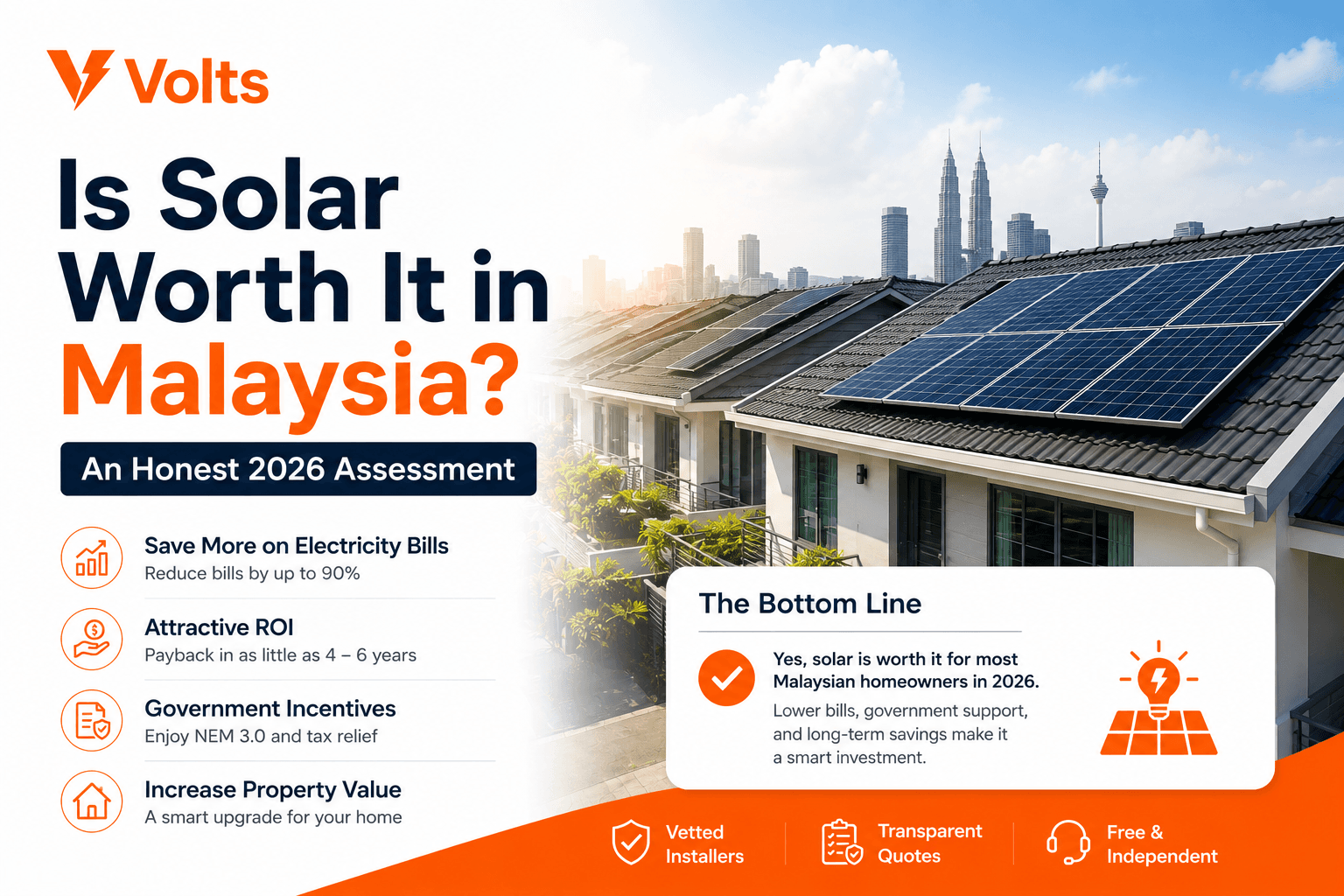
The short answer: yes, solar is worth it for many Malaysian homeowners, but not for everyone. If your bill is consistently high, your roof is suitable, and your installer is competent, the numbers can be strong. If any of those three fail, ROI can disappoint.
Key takeaway: In Malaysia, solar is usually financially attractive for homes with RM200+ monthly TNB bills, with many systems landing around 5-7 year payback when designed and installed properly.
This article gives the honest version, including when solar is a bad idea. Before deciding, run your own numbers in the Volts calculator, then compare with this framework.
Why this question matters more in 2026
Solar has become mainstream, but sales messaging still swings between hype and fear. Some people are told solar is guaranteed huge savings with no caveats. Others are told policy changes will make it pointless.
Reality is in the middle. Solar is a long-term infrastructure decision tied to your roof, lifestyle, tariff trajectory, and installer execution. Good decisions come from realistic assumptions, not emotional pitch decks.
Quick framework: when solar is usually worth it
Solar tends to be worth serious consideration when most of these are true:
- Monthly TNB bill averages RM200 or above.
- You plan to stay in the property for 5+ years.
- Roof has adequate unshaded area and reasonable condition.
- You use meaningful electricity during daylight hours.
- You choose an installer with proven engineering and support capability.
If your bill is RM80-RM150 and daytime usage is very low, payback can stretch too long. It can still be done for environmental reasons, but financial ROI becomes less convincing.
Worked example: RM450 bill, 8kW system, RM38,000 after rebate
Let us use a concrete scenario because this is where clarity comes from.
Assumptions
- Current average monthly bill: RM450
- System size: 8kW
- Net installed price after applicable rebate: RM38,000
- Household remains in home for at least 8 years
- Typical degradation: 0.5%-0.7% per year
- Inverter replacement budget included around year 10-15
What this can look like
For many similar homes, monthly net bill reduction can be substantial, especially with daytime loads like aircond, fridge, router, and appliances operating regularly. Savings vary by usage timing, roof performance, and policy context, but this profile often lands in mid single-digit payback years.
At rough planning level, this kind of setup frequently lands around 5-7 year payback. After payback, ongoing savings continue while the system still has many productive years left.
Why this example is not universal
Same bill does not always mean same savings. Two homes with RM450 bills can have different roof orientation, shading, and daytime behavior, causing very different outcomes. That is why sizing should be data-driven, not copy-paste from a neighbor.
The bill threshold reality: why RM200+ matters
The RM200 threshold is not a magic law, but it is a practical screening point in Malaysia. With higher bills, fixed installation cost is spread over more displaced kWh, so economics usually improve. With lower bills, there is less consumption to offset, and system right-sizing becomes harder.
This does not mean "below RM200 never worth it." It means you need tighter design and realistic expectations. Financially, the opportunity cost of capital matters more in low-bill scenarios.
Payback explained without jargon
Payback is the number of years for cumulative net savings to recover your upfront cost. A 6-year payback does not mean zero value after year 6. It means years 7 onward are mostly positive cash-flow years minus planned lifecycle costs.
A good ROI conversation includes:
- Upfront installed price after rebates.
- Expected annual generation and degradation.
- Maintenance and cleaning assumptions.
- Inverter replacement allowance.
- Export/offset behavior under current framework.
If a proposal omits these, the payback number is marketing, not analysis.
Where SuRIA RM3,000 rebate changes the picture
For qualifying households and campaigns where available, a SuRIA RM3,000 rebate can materially improve entry economics. It is not enough to rescue a poor-quality project, but it can shorten payback and reduce financing pressure.
Always verify eligibility criteria, timing, and allocation status because rebate programs have limits and updates. Treat rebates as bonus support, not the sole reason to install.
In practical terms, RM3,000 on a medium-size residential project can improve confidence for households sitting at the edge of affordability. It also helps when comparing solar versus other home upgrades competing for the same cash.
When solar is NOT worth it (honest section)
Solar is not automatically smart for every home. Here are cases where you should pause or skip:
- You are likely moving within 2-3 years and buyer profile may not value the system.
- Roof condition is poor and major roof replacement is imminent.
- Heavy permanent shading significantly cuts generation potential.
- Your bill is low and mostly nighttime usage with little daytime demand.
- Installer quality is doubtful and contract terms are vague.
It is better to postpone than to force a weak project. The wrong installer can destroy ROI faster than tariff changes can.
Installer quality matters more than panel brand
Many homeowners focus only on panel wattage and brand names. In reality, project outcomes are heavily influenced by design quality, installation workmanship, and after-sales responsiveness. A premium panel with poor wiring, weak mounting, or bad service can still underperform.
Strong installers usually show:
- Clear roof layout and realistic generation assumptions.
- Detailed scope and transparent exclusions.
- Proper documentation and commissioning process.
- Verifiable support process when faults occur.
Weak installers usually sell "cheap now" and disappear later. That is the costliest version of solar.
TNB tariff risk: friend and uncertainty
Electricity tariff evolution affects solar economics over time. If retail tariffs trend upward, self-generated solar value generally improves. If tariff structure changes in ways that reduce offset value, projected savings may shift.
This is why honest proposals use conservative assumptions instead of aggressive best-case forecasts. Solar should still make sense under reasonable downside scenarios, not only under optimistic projections.
A practical way to handle tariff risk is scenario analysis:
| Scenario | Tariff trend | Likely effect on ROI |
|---|---|---|
| Conservative | Flat/slower increase | Payback may extend modestly |
| Base case | Gradual increase | ROI remains attractive for suitable homes |
| Upside | Faster increases | Payback often improves |
If your proposal has only one perfect-case model, request three scenarios before committing.
Property value impact: real but not automatic
Well-installed solar can improve resale attractiveness, especially for buyers aware of TNB savings and rising energy costs. It can also signal modernized home infrastructure. But value uplift is not guaranteed and depends on market segment, location, and documentation quality.
To maximize value perception:
- Keep full records of installation and warranties.
- Maintain clean, professional-looking roof and wiring.
- Show historical bill savings when possible.
A neglected-looking system can have the opposite effect.
Environmental benefit: important, but keep it honest
Solar reduces grid electricity dependence and lowers household carbon footprint over time. This is meaningful, especially for families balancing cost savings and sustainability goals. However, most households still prioritize monthly cash flow, and that is reasonable.
The strongest decision is one that works both financially and environmentally. You should not need to choose one or the other if the project is designed properly.
Common myths that distort decisions
Myth 1: "Solar only works in hot weather"
Panels generate from sunlight, not ambient heat. High temperatures can slightly reduce efficiency, but Malaysia still has strong annual solar potential. Heat is a design factor, not a deal-breaker.
Myth 2: "Rain makes cleaning unnecessary forever"
Rain helps, but haze film and droppings still reduce output over time. Most homes still benefit from cleaning every 3-6 months.
Myth 3: "Any installer is fine if price is low"
Cheap quotes often hide weaker components, shortcuts, or poor support terms. Lowest upfront cost can become highest lifetime cost.
Myth 4: "If policy changes, all value disappears"
Policy and tariff updates can alter outcomes, but properly sized self-consumption systems retain core value because you are offsetting your own usage. Avoid all-or-nothing thinking.
Financial risks you should include in your math
Honest ROI includes downside planning. If your proposal refuses to discuss risks, that is a red flag.
Include these in your model:
- Mild underperformance versus optimistic forecast.
- Normal annual degradation (0.5%-0.7%).
- Inverter replacement around year 10-15.
- Minor periodic maintenance and cleaning.
- Potential policy/tariff variability.
When these are included and ROI still works, confidence goes up.
How to stress-test a quote in 15 minutes
Use this quick method before signing:
- Compare proposed annual kWh against roof orientation reality.
- Remove best-case assumptions and use moderate numbers.
- Add lifecycle costs (maintenance + inverter event).
- Check contract for hidden exclusions and escalation clauses.
- Validate installer legitimacy and support process.
If the deal still looks attractive after stress-testing, it is probably a healthier project.
Comparing "install now" versus "wait"
Some households delay because they expect panel prices to keep falling. Price movements can happen, but waiting also means paying higher utility bills in the meantime. There is an opportunity cost to inaction.
Decision logic:
- If your roof and finances are ready and quote quality is high, waiting may not add much value.
- If roof is near replacement or your usage pattern is about to change, waiting can be rational.
- If you have only one weak quote, wait and collect better proposals.
Timing is strategic, not emotional.
How Solar ATAP ecosystem context affects homeowners
Most homeowners do not need policy-level depth, but you should know the operating basics in Malaysia's residential context. Production profile, offset mechanics, and documentation discipline influence your practical savings. Confusion here often leads to wrong sizing decisions.
If you want a quick plain-English refresher before committing, read how solar works in Malaysia. Then return to your numbers with clearer assumptions.
What a good "yes" decision looks like
A good solar decision is usually boring on paper:
- Reasonable price relative to size and scope.
- Realistic generation assumptions with transparent methodology.
- Installer with clean execution history and support responsiveness.
- Payback that still works under conservative scenarios.
- Homeowner with stable occupancy horizon.
No hype needed. Just disciplined inputs and honest math.
What a risky "yes" decision looks like
A risky decision usually contains one or more of these:
- Sales promise of "bill almost zero guaranteed" without caveats.
- Quote that is dramatically cheaper but vague in scope.
- No clear handover documents, maintenance plan, or support SLA.
- Financing pressure without full contract review.
- Savings model that excludes major lifecycle costs.
If any two of these appear together, pause and reassess.
Practical decision checklist before paying deposit
| Checklist item | Status to confirm |
|---|---|
| Monthly bill and daytime usage profile reviewed | Yes |
| Roof suitability and shading risk validated | Yes |
| At least three quotes compared apples-to-apples | Yes |
| Rebate eligibility (including SuRIA if relevant) checked | Yes |
| Contract milestones and exclusions clarified | Yes |
| Maintenance and inverter lifecycle costs included | Yes |
| Installer support and escalation path verified | Yes |
This checklist is simple but prevents most avoidable regret.
Bottom line: is solar worth it in Malaysia?
For many households with RM200+ monthly bills, the answer is still yes. In well-executed projects, 5-7 year payback remains realistic, and long-run savings can be meaningful. But "worth it" depends less on solar hype and more on project discipline.
If your profile resembles the RM450 bill example and your roof is suitable, solar can be one of the better long-term home upgrades you make. If you are unsure, run your case on the Volts calculator, compare scenarios, and choose installer quality over sales pressure.
Ready to see your numbers?
Submit a verified solar enquiry and get free quotes from SEDA-verified installers, 100% free for homeowners.
Calculate My Savings