
Solar Battery Storage in Malaysia: Is It Worth It in 2026?
Home battery storage in Malaysia — costs, backup power reality, vs net metering, and when a battery makes financial sense for your home.
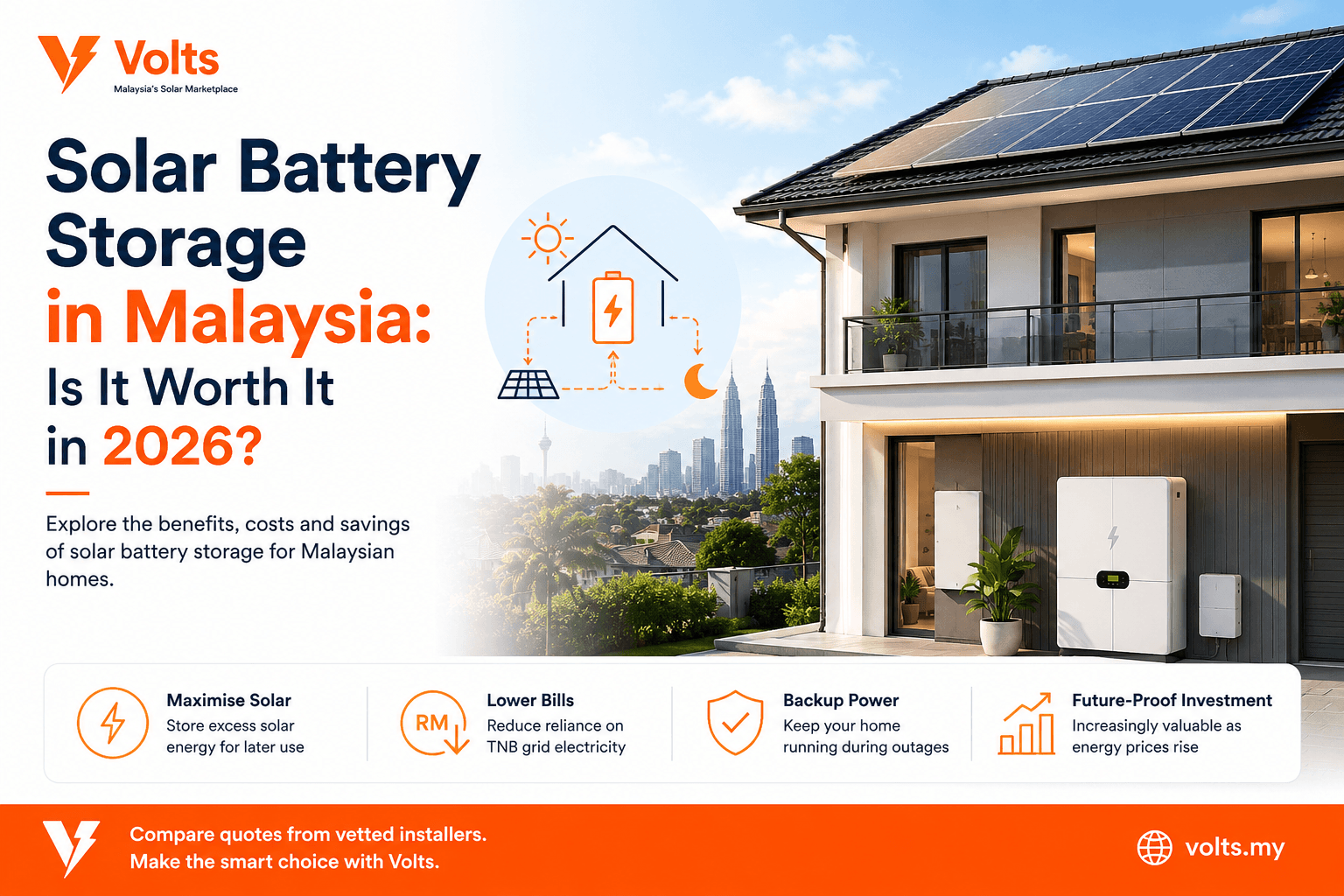
Battery storage is the most asked-about upgrade in Malaysian solar — and the most misunderstood. Sales decks show sleek wall units and promise "energy independence." The reality for most grid-connected homes in 2026 is more nuanced.
Key takeaway: For the average Malaysian homeowner with stable TNB supply and net metering, battery storage rarely improves financial ROI today. It makes sense when backup power during outages is a genuine priority, or when your usage pattern wastes most of your solar export.
This guide covers what batteries actually do, what they cost, and how to decide.
What home battery storage does
A solar battery stores excess DC electricity generated during the day for use at night or during a power cut. It sits between your panels and your home, managed by a hybrid inverter.
Three modes matter:
- Self-consumption boost — use more of your own solar instead of exporting to TNB.
- Backup power — keep selected circuits running during a grid outage.
- Time-shifting — store cheap/off-peak grid power for peak use (limited relevance in Malaysia's current flat residential tariff).
Most Malaysian homeowners considering batteries are really asking about modes 1 and 2.
How net metering changes the maths
Under TNB net metering, surplus solar exported to the grid earns bill credits at an export rate lower than your retail tariff — but still meaningful. This acts as a form of "virtual storage": TNB holds the value of your excess power until you draw from the grid at night.
Adding a physical battery means:
- You keep more power at home instead of exporting — good if export rates are low.
- You avoid buying from TNB at night — but you paid RM 15,000–RM 35,000 for the battery to do this.
- You lose bill credits on stored energy you consume yourself — the credit you would have earned is forgone.
The financial crossover depends on the gap between your retail tariff and export credit, plus battery cost and cycle life. In 2026, for most Peninsular homes, the battery premium exceeds the savings it generates over its warranty life.
What batteries cost in Malaysia (2026)
Indicative installed ranges for residential lithium systems:
| Battery capacity | Typical installed range | Best for |
|---|---|---|
| 5 kWh | RM 15,000 – RM 22,000 | Night-time backup for essentials |
| 10 kWh | RM 25,000 – RM 35,000 | Larger homes, longer backup |
| 15 kWh+ | RM 35,000 – RM 50,000+ | High consumption or extended backup |
These are add-on costs on top of your solar system. A hybrid inverter (battery-ready) adds roughly RM 1,500–RM 4,000 compared to a standard string inverter — before the battery itself.
Brands commonly quoted
- BYD (Battery-Box)
- Huawei (LUNA series)
- Tesla Powerwall (less common locally but appearing in premium quotes)
- Pylontech (popular in budget-hybrid setups)
Always confirm whether the price includes installation, inverter compatibility, and backup wiring to a dedicated sub-board.
Backup power: what actually works
This is where expectations diverge most from reality.
What a battery CAN do
- Keep selected circuits running during a TNB outage — typically lights, fans, fridge, phone charging, and Wi-Fi.
- Provide silent backup without a generator.
- Switch over in seconds (for well-designed hybrid systems with EPS/backup port).
What a battery usually CANNOT do
- Run your full home including air conditioning for hours — a 10 kWh battery drains fast on a 1.5 HP aircon.
- Provide whole-home backup unless specifically engineered with a large battery and automatic transfer switch.
- Guarantee backup if the installer did not wire a dedicated backup circuit — many "battery-ready" installs skip this to save cost.
Ask explicitly: "Which circuits are on backup, and for how many hours at normal load?" Get it in the quotation scope.
When battery storage DOES make sense
1. Frequent or extended power outages
If you live in an area with regular TNB disruptions and rely on medical equipment, home office uptime, or simply want fridge security, backup value is real — even if the financial ROI is poor.
2. High export, low night consumption
If your system exports 60%+ of production because nobody is home during the day, a battery can capture that energy. Run the numbers: compare the annual value of saved export credits vs battery cost over 10 years.
3. Planned tariff structure changes
If TNB introduces meaningful time-of-use pricing for residential customers, batteries gain financial appeal by storing cheap off-peak grid power or mid-day solar for evening peak. This is not the norm today, but it is a valid future-proofing argument.
4. Off-grid or weak-grid locations
Rural properties, farmhouses, or east Malaysia locations with unreliable supply may benefit more than typical Klang Valley terrace homes.
When to skip the battery
- Stable TNB supply and normal daytime usage patterns.
- Tight budget — every ringgit spent on battery is a ringgit not spent on larger solar capacity, which usually saves more.
- "Just in case" without a defined backup need — you are paying RM 20,000+ for peace of mind you may never use.
- Small system (3 kW) — the battery cost can exceed the solar system itself.
Battery vs bigger solar array
A common decision: RM 25,000 for a 10 kWh battery, or RM 25,000 for ~5 extra kW of panels?
For most grid-connected homes, more panels produce more bill offset through net metering and self-consumption. A battery only helps if the extra panels would be wasted on export you cannot monetise effectively.
Quick rule: if your export ratio is below 40%, expand solar first. If export is above 60%, model a battery against the forgone credits.
Key questions before buying
- Hybrid inverter included, or retrofit later? Retrofit is possible but often costs more.
- Which circuits get backup? Insist on a circuit list, not "whole house."
- Battery warranty and cycle life — most offer 10 years or 6,000 cycles; understand the capacity guarantee at end of warranty (e.g. 70% remaining).
- Who services a fault? Installer, distributor, or manufacturer — and typical response time.
- Can I add battery later? If yes, confirm the inverter model supports it and the add-on price.
Bottom line
Battery storage in Malaysia is a lifestyle and resilience purchase more than a financial one in 2026. Net metering already solves the day-night mismatch for most homes at a fraction of the cost.
If outage backup matters to you, size the battery for specific circuits and hours — not marketing photos of a full mansion running on one wall unit. If savings are the goal, start with the right system size via the Volts calculator and compare solar-only quotes first.
Ready to see your numbers?
Get 3 free quotes from SEDA-verified installers — 100% free for homeowners.
Calculate My Savings