
Solar Panels for Condos and Apartments in Malaysia: What Is Actually Possible
Can condo and apartment owners install solar in Malaysia? Strata rules, shared roofs, balcony options, and realistic paths to clean energy.
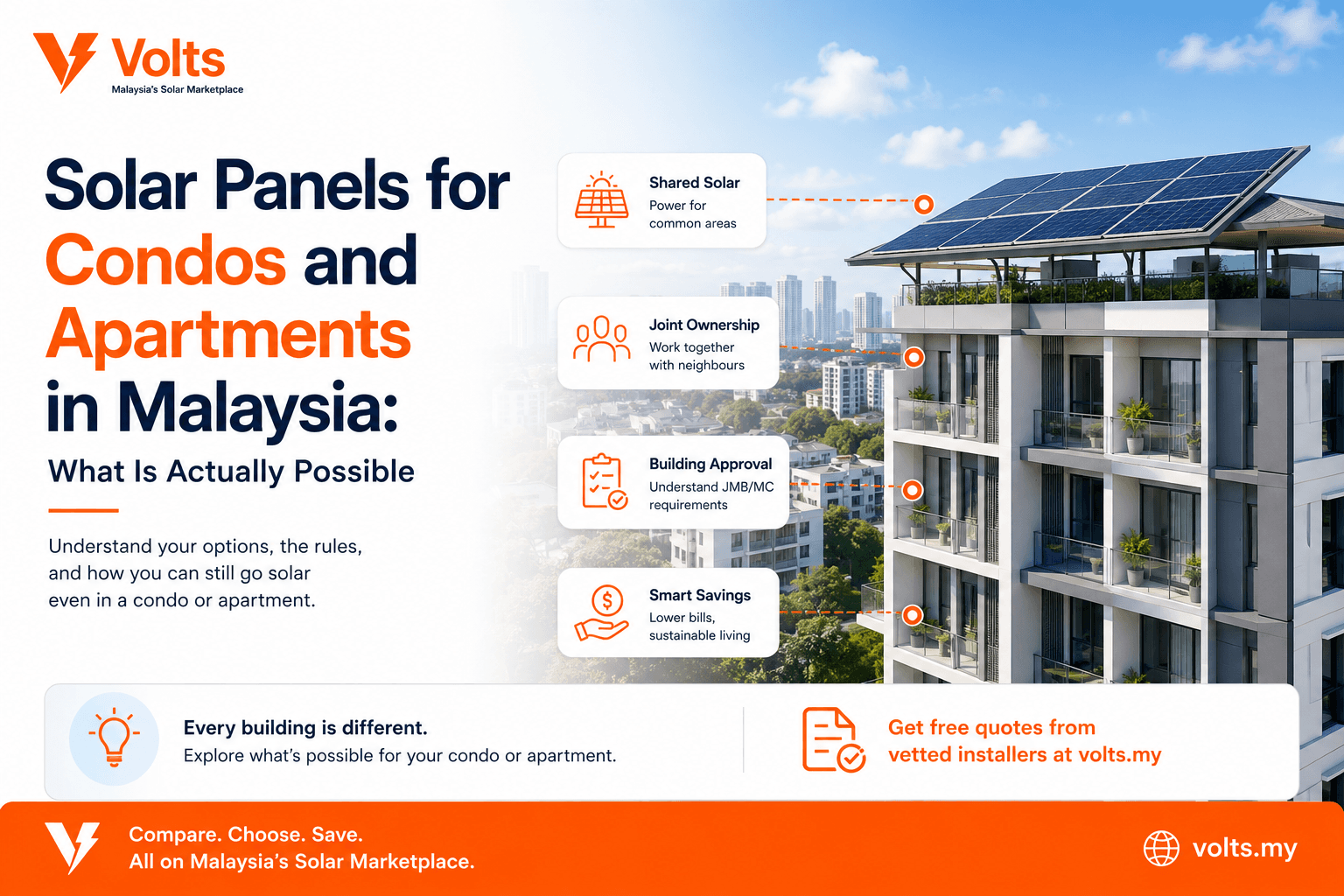
If you live in a high-rise, you have probably searched "solar panel condo Malaysia" and found conflicting answers. The short version: it is complicated, but not always impossible — and the path depends entirely on your building structure and management corporation (MC) approval.
Key takeaway: Condo solar in Malaysia is primarily a governance and roof-access issue, not a technology issue. Penthouse and top-floor units with private roof rights have the clearest path. Most apartment owners should focus on community solar advocacy or renewable energy tariffs rather than individual rooftop installs.
Why condos are different from landed homes
Landed homeowners own their roof. Condo owners own their unit airspace — the roof is common property managed by the Joint Management Body (JMB) or Management Corporation (MC).
Installing panels on common property requires:
- MC/JMB approval at a general meeting (often special resolution).
- Structural engineer assessment of loading capacity.
- Insurance and liability arrangements for building-wide risk.
- Agreement on who owns, maintains, and benefits from the system.
This is why most individual condo solar projects stall — not because the panels won't fit, but because the approval pathway is unclear.
Scenario 1: Penthouse or unit with private roof access
Some condos allocate exclusive use of a rooftop area to penthouse or top-floor units via the strata title or deed of mutual covenant (DMC).
If you have documented exclusive roof rights:
- The installation pathway is similar to a landed home, but MC notification and compliance with building bylaws is still required.
- A structural assessment is mandatory — condo roofs are not always designed for panel loading.
- Waterproofing responsibility must be defined — a leak affecting units below becomes a strata liability.
Action step: Check your sale and purchase agreement and DMC for "exclusive use area" clauses covering the roof terrace. If it exists, request written MC acknowledgement before getting quotes.
Scenario 2: Shared rooftop — community solar
The more scalable model for condos is a shared system where the MC installs solar on the common rooftop and distributes benefits to all unit owners.
How it works
- Panels are installed on the communal flat roof (typical of many Malaysian condo designs).
- Power is connected to the main building TNB account (master meter), reducing common area electricity costs — lifts, lighting, pumps, clubhouse.
- Savings reduce sinking fund or maintenance fee pressure over time.
Why this is gaining interest
- One approval process, one installer, one TNB application.
- Benefits all residents — not just the top floor.
- Aligns with Green Building Index (GBI) and developer ESG reporting.
Challenges
- MC members may lack technical knowledge to evaluate proposals.
- Upfront cost comes from building funds — requires owner vote.
- Benefit allocation (equal split vs usage-based) needs agreement.
- Not every condo roof has suitable orientation or structural capacity.
If you are passionate about solar, propose a community solar feasibility study to your JMB rather than trying to install panels on your balcony alone.
Scenario 3: Balcony and plug-and-play panels
You may have seen portable solar panels or "balcony solar" kits marketed online. In Malaysia:
- Small plug-in devices (100–400 W) that feed a wall socket exist globally but occupy a grey area under TNB regulations and condo bylaws.
- Most MCs prohibit alterations to building facade including balcony-mounted panels.
- TNB's net metering programme is designed for grid-tied rooftop systems, not ad-hoc plug-in devices.
- Safety concerns (wind loading, cable routing, fire risk) make MCs wary.
Our honest advice: do not install balcony solar without explicit MC and TNB clarity. The savings on a 300 W kit are minimal, and the strata dispute risk is disproportionate.
Scenario 4: No roof access — alternatives for apartment dwellers
If individual solar is not viable, you still have options:
Switch to a green tariff (where available)
TNB and other providers occasionally offer renewable energy add-ons or green power programmes. Check current availability — these change with policy.
Reduce consumption first
LED lighting, efficient appliances, and smart aircon habits reduce bills without any installation approval. For many apartment dwellers, efficiency upgrades have better ROI than fighting for roof access.
Advocate for community solar
Organise neighbours, present a business case to the JMB, and connect with installers experienced in commercial/strata projects. Volts can help homeowners understand system economics — share calculator results with your MC as part of a feasibility proposal.
What the regulations say (simplified)
- SEDA registers solar installations under programmes like NEM — the applicant is typically the TNB account holder. For condos, this is often the MC (common meter) or individual unit owner (separate meter).
- Suruhanjaya Tenaga (ST) and Bomba requirements apply to commercial-scale installs on building roofs.
- Strata Management Act 2013 governs alterations to common property — usually requires general meeting approval.
Individual unit owners with their own TNB meters (rare in condos but exists in some loft-style developments) have a cleaner regulatory path.
Questions to ask your JMB/MC
- Has the building ever assessed rooftop solar feasibility?
- Is there a structural load report for the roof?
- What is the process for proposing capital expenditure from building funds?
- Does the building insurance cover rooftop installations?
- Are there existing facade or alteration bylaws that block balcony mounts?
Penthouse checklist: if you have roof rights
- Confirm exclusive use in strata documents
- Obtain MC written acknowledgement (not just verbal from security)
- Commission structural engineer roof assessment
- Define waterproofing warranty responsibility
- Ensure installer has commercial/high-rise experience (not just terrace jobs)
- Verify TNB account is in your name for net metering application
- Notify insurer of installation
Bottom line
Condo solar is not off the table — but it is a building-level conversation for most residents. Penthouse owners with private roof rights have the simplest path. Everyone else should push for community solar or focus on efficiency while monitoring policy changes.
Landed homeowners can compare verified quotes on Volts today. Condo residents can use the same calculator to model building-level savings for MC proposals.
Ready to see your numbers?
Get 3 free quotes from SEDA-verified installers — 100% free for homeowners.
Calculate My Savings