
How to Pay for Solar in Malaysia: Financing Options Compared
Solar financing in Malaysia. Personal loans, hire purchase, in-house instalments, EPF considerations, and how to choose without overpaying.
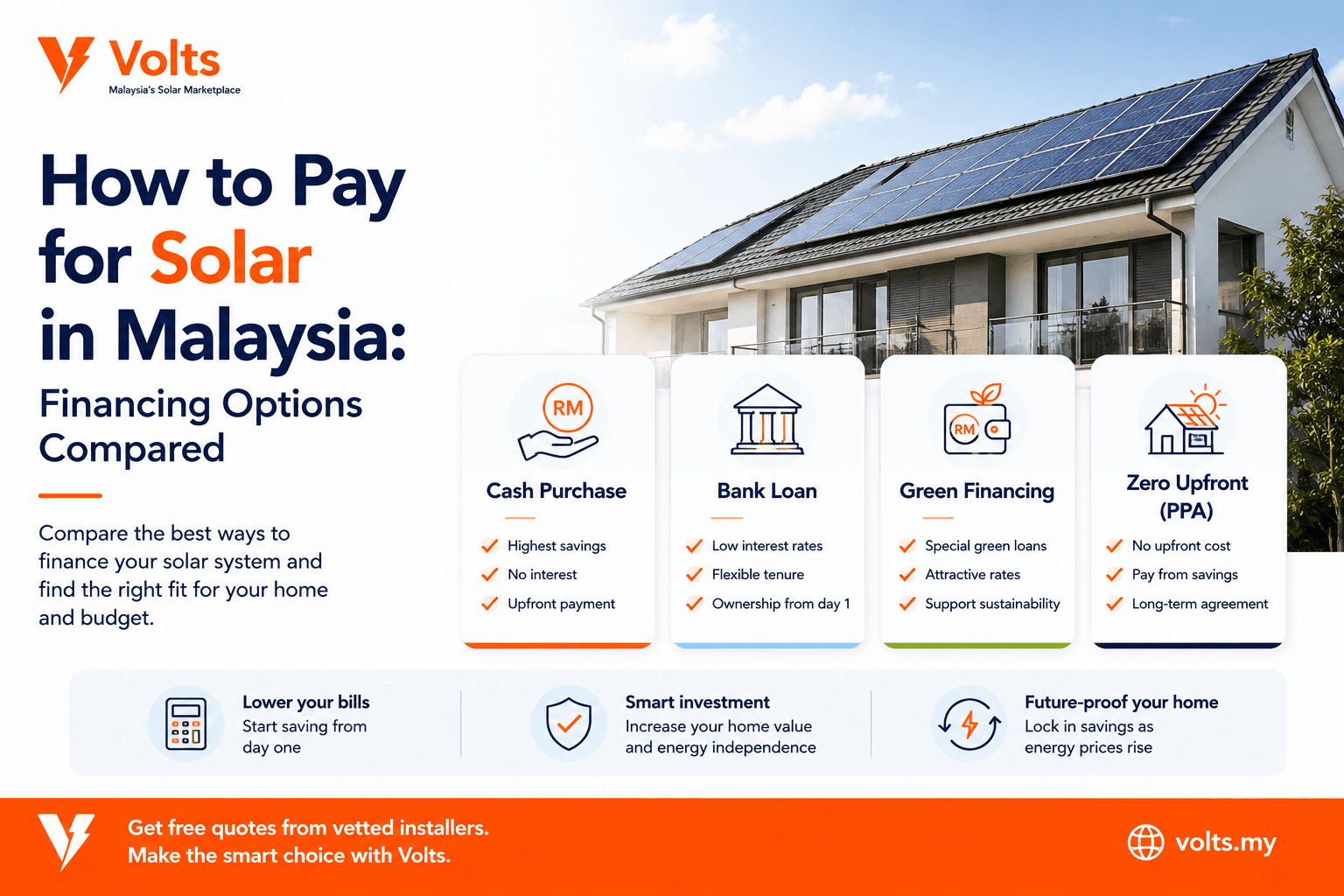
A RM 25,000 solar system pays for itself over time — but you still need to fund the upfront cost. In Malaysia, most homeowners pay cash, but financing options are growing. The wrong loan can erase your solar savings entirely.
Key takeaway: Treat solar financing like any major home purchase — compare total cost of borrowing, not just monthly instalments. A low monthly payment over 10 years at 8% interest can cost RM 8,000+ more than paying cash, which may exceed your first five years of electricity savings.
The default: pay cash
Cash payment remains the most common and financially efficient method for Malaysian residential solar.
Advantages:
- No interest charges — full savings from day one.
- Stronger negotiating position with installers (some offer 2–5% cash discounts).
- Simplest ownership — no lien or financing company involved.
When it makes sense: You have sufficient savings after maintaining an emergency fund (3–6 months of expenses). Solar ROI improves significantly without financing overhead.
Option 1: Personal loan (unsecured)
Most banks offer personal loans from RM 5,000 to RM 150,000 with tenures of 1–7 years (some up to 10).
Typical terms (2026)
| Factor | Typical range |
|---|---|
| Interest rate | 6% – 12% p.a. (flat or effective) |
| Tenure | 3 – 7 years |
| Approval time | 1 – 5 working days |
| Collateral | None (unsecured) |
Worked example
RM 25,000 solar system, 7-year personal loan at 8% p.a. effective:
- Monthly instalment: roughly RM 390
- Total repaid: roughly RM 32,700
- Interest cost: ~RM 7,700
Your solar system saves perhaps RM 1,700–RM 2,200/year in electricity. Interest eats a large share of early-year savings — payback extends from ~12 years to ~18 years when financing cost is included.
Tips
- Compare effective interest rate (EIR), not flat rate — flat rates look cheaper than they are.
- Check for early settlement penalties.
- Use bank comparison tools; rates vary significantly between institutions.
- A personal loan keeps the solar asset fully yours — no repossession risk on the panels.
Option 2: Hire purchase / installer financing
Some installers partner with finance companies to offer in-house instalment plans — similar to buying furniture on HP.
Typical terms
| Factor | Typical range |
|---|---|
| Interest rate | 5% – 10% p.a. |
| Tenure | 2 – 5 years |
| Down payment | 10 – 30% |
| Approval | Often faster than bank loans |
Advantages
- Convenient — approved at point of quote.
- May accept lower credit scores than banks.
- Promotional 0% periods occasionally available (verify no hidden fees).
Risks
- Markup built into system price — "0% instalment" sometimes means the cash price is inflated. Always ask for the cash price separately.
- Shorter tenures mean higher monthly payments.
- Terms may include retain ownership until final payment — understand who owns the system if you default.
Critical check
Get the cash price and financed price for the identical scope. If the financed package is RM 3,000+ higher before interest, you are paying a hidden premium.
Option 3: Home equity / refinancing
Homeowners with an existing property mortgage may consider topping up or refinancing to release equity for solar.
When it works
- You are already refinancing for better mortgage rates.
- Your home equity is substantial and solar is bundled into a broader renovation.
- Mortgage rates (3–5%) are lower than personal loan rates (7–10%).
When to avoid
- Extending your mortgage over 25–30 years for a 25-year asset (panels) means you pay interest far exceeding solar savings.
- Using home as collateral for a RM 25,000 solar system is usually disproportionate.
If you go this route, treat the solar portion as a 7-year sub-loan mentally — do not spread it across your full mortgage tenure without calculating the total cost.
Option 4: EPF withdrawal (Account 2)
EPF members may withdraw from Account 2 for housing-related expenses under specific categories. Whether solar qualifies depends on the current EPF withdrawal scheme classification.
As of common practice:
- Solar installation may not clearly qualify under standard housing withdrawal categories (purchase, renovation, building).
- Rules change — verify directly with KWSP/EPF before planning around this.
- Opportunity cost matters: EPF historical returns and retirement compounding may exceed solar savings over the same period.
Do not assume EPF covers solar until you have written confirmation for your specific case.
Option 5: Green loans and government programmes
Malaysia has periodically offered green financing incentives through banks participating in Bank Negara's green taxonomy. Availability varies by year and bank.
Watch for:
- Green personal or home improvement loans with reduced rates.
- SuRIA rebate (RM 3,000 for eligible residential systems from June 2026) — this reduces principal, improving any financing scenario.
- State-level incentives — Selangor and other states occasionally run energy programmes; check current listings.
The SuRIA rebate directly improves payback: on a RM 22,000 system, RM 3,000 off brings effective cost to RM 19,000 — roughly 14 months of additional savings in your pocket.
How to choose: decision framework
Ask yourself three questions:
1. What is the total cost of borrowing?
Calculate: (monthly instalment × months) − principal = total interest. Add any processing fees.
2. What is my all-in payback period?
(Ssystem cost + total interest − rebates) ÷ annual savings = financed payback in years.
If financed payback exceeds 15 years on a system with a 25-year panel life, the loan terms are too expensive.
3. Can I afford the monthly payment without strain?
Solar savings offset your TNB bill — but the loan payment is fixed. If your bill was RM 350/month and the loan is RM 390/month, you pay more out of pocket until the loan clears, even though total energy costs are lower long-term.
Financing comparison table
| Method | Typical rate | Speed | Best for | Main risk |
|---|---|---|---|---|
| Cash | 0% | Immediate | Best long-term ROI | Large upfront outlay |
| Personal loan | 6–12% | 1–5 days | Flexible, no collateral | Interest erodes savings |
| Installer HP | 5–10% | Same day | Quick approval | Inflated system price |
| Mortgage top-up | 3–5% | Weeks | Already refinancing | Long tenure overpayment |
| EPF Account 2 | N/A | Weeks | If eligible | Retirement opportunity cost |
Red flags in solar financing offers
- "Zero cost solar" or "free solar" — you pay via inflated pricing or long contracts.
- Monthly payment equals your TNB bill marketing — compare total 5-year outflow, not just the headline.
- No cash price disclosed — always ask what you would pay today without financing.
- Pressure to finance through one partner — you can arrange your own bank loan separately.
- Interest rate quoted as flat — insist on effective rate for comparison.
Practical recommendation
- Get your system cost right first — compare at least three quotes via Volts so you know the fair cash price.
- Apply SuRIA rebate if eligible — reduces principal before deciding on financing.
- If you must borrow, prefer the lowest effective rate over the shortest affordable tenure.
- Avoid financing beyond 7 years for a solar system — the interest drag outweighs the benefit.
- Pay cash if you can — solar's financial case is strongest when savings are not shared with a bank.
Bottom line
Solar financing can make sense when the interest cost is modest and the tenure is short. It destroys value when a RM 25,000 system becomes a RM 35,000 repayment over a decade.
Know your fair installed price, run the total interest calculation, and only then decide how to pay. The panels produce the same electricity whether you pay cash or credit — but your wallet feels the difference for years.
Ready to see your numbers?
Submit a verified solar enquiry and get free quotes from SEDA-verified installers, 100% free for homeowners.
Calculate My Savings