
Solar Inverter Types Explained: String, Micro and Hybrid (Malaysia Guide)
String vs micro vs hybrid inverters for Malaysian homes. How each works, pros and cons and which type fits your roof and budget.
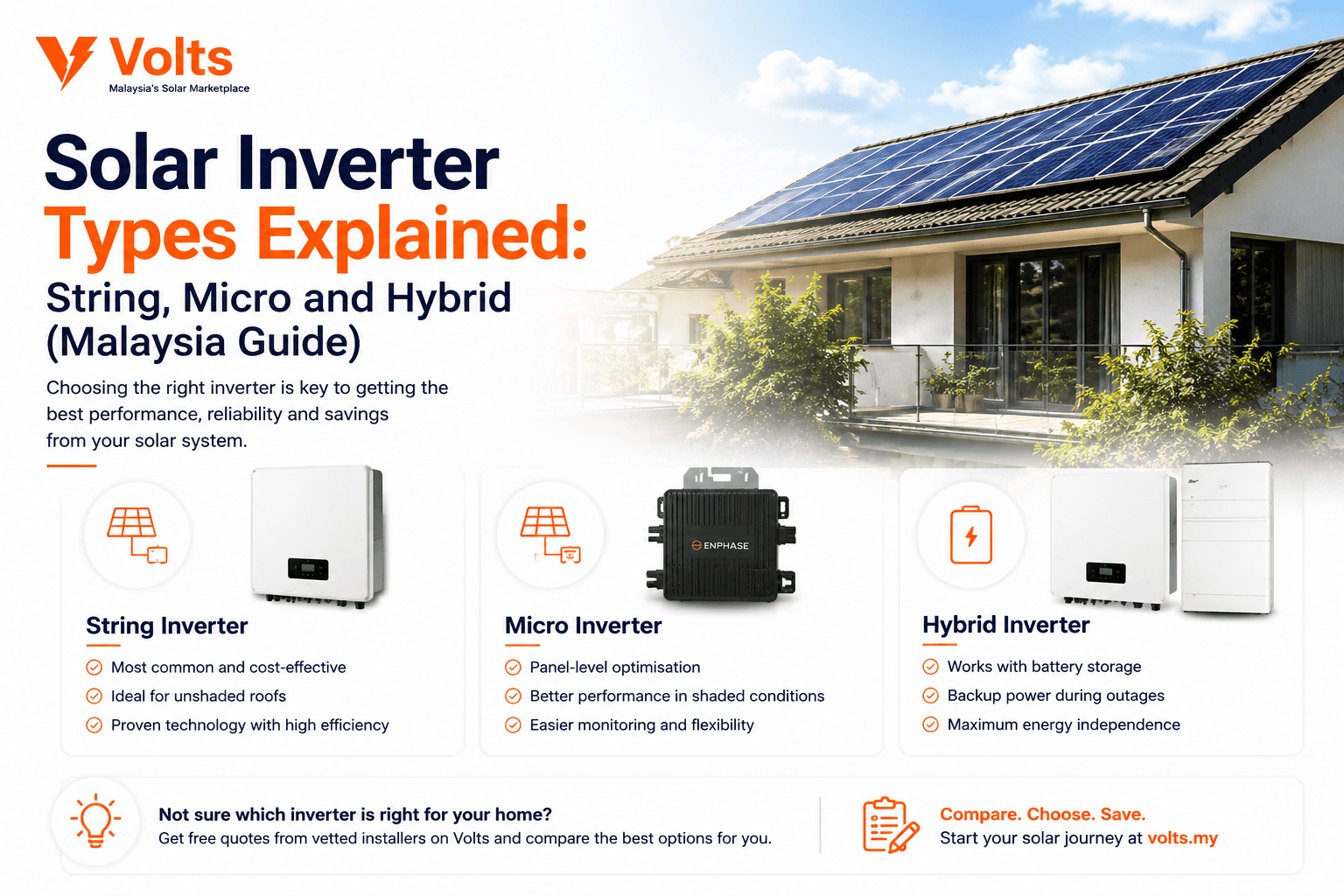
Panels get the attention, but the inverter is the brain of your system. It converts DC electricity from your roof into AC power your home can use, and it shapes how your system handles shade, faults, and future battery upgrades.
Key takeaway: For most Malaysian landed homes with a clean, unshaded roof, a quality string inverter is still the cost-effective default. Choose microinverters when partial shading or complex roof layouts would hurt a string design. Consider hybrid inverters only if you are seriously planning battery storage within the next few years.
This guide explains the three main inverter types you will see in local quotes — without the jargon overload.
What an inverter actually does
Solar panels produce direct current (DC). Your lights, air conditioner, and TNB meter run on alternating current (AC). The inverter sits between the two.
It also:
- Tracks maximum power from your array (MPPT).
- Monitors system health and fault codes.
- Interfaces with TNB's bidirectional meter for net metering export.
- (For hybrid models) manages battery charge and discharge.
Inverter choice affects upfront cost, efficiency under shade, maintenance access, and whether you can add batteries later without replacing core hardware.
Type 1: String inverter (central inverter)
One inverter — usually wall-mounted in your car porch, garage, or utility area — serves the entire panel array. Panels are wired in series "strings," and the inverter converts the combined output.
How it works in practice
A typical 5 kW terrace installation might use 12 panels wired in two strings, feeding a single 5 kW string inverter. If one string underperforms due to shade, the whole string's output can drop — that is the main limitation.
Pros
- Lower cost per kW — one unit instead of many.
- Simple to service — a single device to inspect or replace.
- Proven track record on Malaysian residential installs.
- Efficient on open, unshaded roofs.
Cons
- Shade sensitivity — a shadow on one panel can drag down the entire string.
- Single point of failure — if the inverter fails, the whole system stops producing until it is repaired.
- Less flexible for roofs with multiple orientations (e.g. east and west sections on different pitches).
Best for
- Terrace and semi-D homes with clear roof exposure.
- Budget-conscious installs where the roof layout is straightforward.
- Homeowners who want the simplest long-term maintenance path.
Typical cost impact
String inverters are usually bundled into the system price. Expect them to represent roughly 8–15% of total installed cost — rarely quoted as a separate line item unless you are comparing premium vs budget brands.
Type 2: Microinverters (panel-level)
Instead of one central unit, each panel (or pair of panels) gets its own small inverter mounted underneath. AC wiring runs from the roof down to your distribution board.
How it works in practice
If a tree branch shades one panel at 4 p.m., only that panel's output drops. The rest keep producing at full capacity. Monitoring is also panel-level — you can see exactly which module is underperforming.
Pros
- Excellent shade tolerance — ideal for roofs with chimneys, water tanks, or neighbour trees.
- Panel-level monitoring — easier to diagnose faults remotely.
- Flexible design — mixed orientations and odd roof shapes are easier to handle.
- No single point of failure — one microinverter fault does not kill the whole system.
Cons
- Higher upfront cost — typically RM 2,000–RM 5,000 more than an equivalent string system on a 5 kW install.
- More rooftop hardware — more components exposed to heat and weather.
- Replacement logistics — a failed unit may require roof access, not just a wall swap.
Best for
- Roofs with known partial shading.
- Complex layouts (L-shaped roofs, multiple pitches).
- Homeowners who want granular production data.
Brands you may see in Malaysia
Enphase is the most common microinverter brand in premium quotes. APsystems and Hoymiles appear in mid-tier offerings. Always confirm the exact model and warranty period in writing.
Type 3: Hybrid inverter (battery-ready)
A hybrid inverter combines string (or sometimes micro) solar conversion with built-in battery management. It can send power to your home, export to TNB, and charge or discharge a battery — all from one unit.
How it works in practice
During the day, solar feeds the home first, then charges the battery, then exports surplus. During a TNB outage (if the system supports backup mode), the battery can keep selected circuits running — though true whole-home backup requires careful design and is not standard on every hybrid quote.
Pros
- Battery-ready without replacing the inverter later.
- Future-proof if electricity tariffs or outage resilience become priorities.
- Single management platform for solar + storage.
Cons
- Higher cost than a standard string inverter — even without the battery attached.
- Battery adds significant expense — often RM 15,000–RM 35,000 on top.
- Backup capability varies — not every hybrid install includes true off-grid switching; clarify this explicitly.
Best for
- Homeowners planning battery storage within 2–3 years.
- Areas with frequent outages who want selected backup (e.g. lights, fridge, Wi-Fi).
- Early adopters watching time-of-use tariff developments.
Honest note on batteries in Malaysia (2026)
For most grid-connected homes with stable TNB supply, battery storage is still a luxury, not a necessity. Net metering already gives you a form of "virtual storage" via bill credits. Batteries make more sense when outage backup is a genuine priority, or when export rates no longer favour sending power back to the grid. We cover this in more detail in the battery storage guide below.
Quick comparison table
| Factor | String inverter | Microinverters | Hybrid inverter |
|---|---|---|---|
| Upfront cost | Lowest | Highest | Mid-high (without battery) |
| Shade performance | Poor to moderate | Excellent | Depends on panel config |
| Maintenance access | Easy (wall unit) | Requires roof access | Easy (wall unit) |
| Battery-ready | No (needs retrofit) | No | Yes |
| Best roof type | Open, simple | Complex or shaded | Any (if planning storage) |
| Typical warranty | 5–10 years | 10–25 years (unit) | 5–10 years |
What to ask your installer
Before signing, put these in writing:
- Exact inverter brand and model number — not just "5 kW inverter."
- Warranty period and who handles claims — manufacturer, installer, or both.
- Shade analysis — if they recommend string on a partially shaded roof, ask why.
- Replacement turnaround — how quickly can they swap a failed unit?
- Battery compatibility — if they propose hybrid, ask which battery models are approved and the add-on cost today vs later.
Common mistakes homeowners make
- Choosing microinverters on a perfectly open roof — you pay a premium without meaningful benefit.
- Accepting a no-name inverter to hit a lower price — inverter failure is the most common major component replacement in years 8–12.
- Buying hybrid "just in case" without a battery plan — you pay more for capability you may never use.
- Ignoring warranty terms — some warranties require registration within 30 days of commissioning. Ask your installer to confirm this is done.
Bottom line
Inverter selection should follow your roof reality and your five-year plan — not whichever type the salesperson prefers to install.
- Clean roof, tight budget → string inverter.
- Shade or complex layout → microinverters.
- Battery within 3 years → hybrid.
Run your numbers first with the Volts calculator, then compare at least three quotes that specify inverter brand, model, and warranty. Hardware specs only matter when the installer has already passed your legitimacy checks.
Ready to see your numbers?
Submit a verified solar enquiry and get free quotes from SEDA-verified installers, 100% free for homeowners.
Calculate My Savings