
How Much Do Solar Panels Cost in Malaysia in 2026? (Full Breakdown)
Full 2026 solar panel cost breakdown by system size in Malaysia — RM prices, what's included, SuRIA rebate, financing, and ROI.
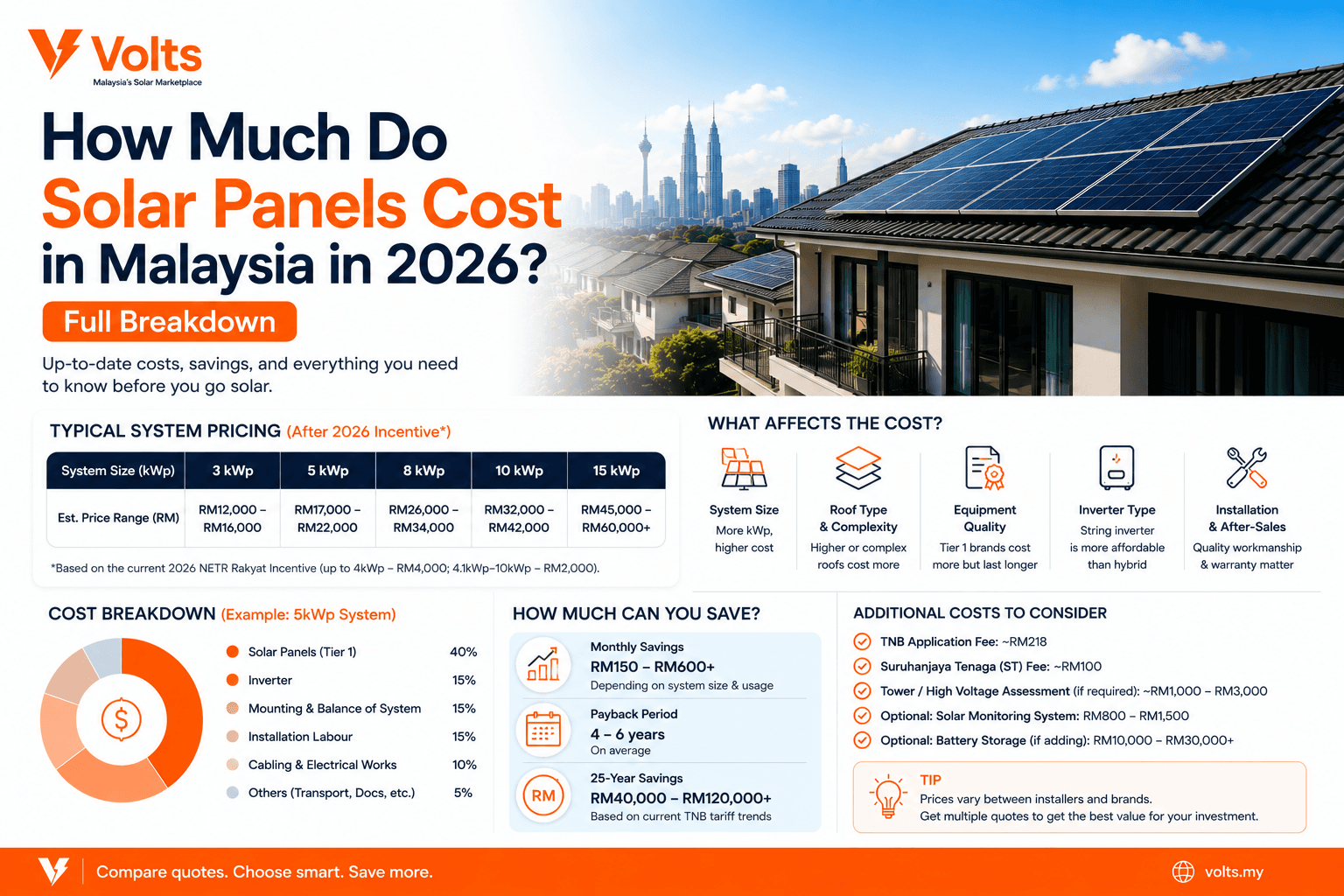
If you are comparing rooftop solar quotes this year, you need real numbers, not ad slogans. In Malaysia, prices vary widely because system size, roof complexity, equipment tier, and service scope are not equal.
Key takeaway: In 2026, most residential systems still land around RM 3,500 to RM 5,500 per kW installed before incentives, with total cost heavily affected by roof layout and component quality. For eligible homes, the SuRIA Home RM 3,000 rebate from June 2026 improves payback, but only if your base quote is already fair.
This guide breaks down typical cost ranges for 3 kW, 5 kW, 8 kW, 10 kW, and 15 kW systems. You will also see what is usually included, what often becomes an extra charge, and how to pressure-test ROI claims.
2026 benchmark: what does solar cost per kW in Malaysia
The useful benchmark for homeowners is installed price per kW, not just total package amount. In 2026, a realistic range for many landed properties is still about RM 3,500 to RM 5,500 per kW.
Lower than that can be possible in straightforward jobs, but often comes with compromised components or missing scopes. Higher than that may still be justified for complex roofs or premium hardware, but it must be explained line by line.
Why this benchmark matters
Installers use different panel wattages and package labels, so total quote comparisons can be misleading. Price-per-kW normalises that and makes apples-to-apples checks easier.
It also helps you catch overcharging quickly. If two proposals use similar components but one is 30% higher per kW, you know where to dig.
Baseline cost table by size
| System size | Typical 2026 range | Approx. median | Typical home profile |
|---|---|---|---|
| 3 kW | RM 11,000 - RM 16,500 | RM 13,500 | Low daytime use, small landed homes |
| 5 kW | RM 17,500 - RM 27,500 | RM 22,500 | Average terrace household |
| 8 kW | RM 28,000 - RM 44,000 | RM 35,000 | Higher daytime use, family home |
| 10 kW | RM 35,000 - RM 55,000 | RM 43,000 | Large terrace or semi-D |
| 15 kW | RM 52,500 - RM 82,500 | RM 65,000 | Large bungalow or heavy usage |
These are indicative ranges, not guaranteed prices. Actual quotes depend on roof condition, engineering scope, and equipment selection.
Cost by system size: quick homeowner context
System size is not just panel count. It also includes inverter matching, electrical protection, racking quality, and documentation scope.
As a rule, 3 kW to 5 kW systems suit lower to moderate usage homes, while 8 kW to 10 kW systems often fit higher-usage family households with stronger daytime demand. Around 15 kW is usually for large homes and should only be chosen with careful load-based sizing.
What drives solar pricing in Malaysia
Two 8 kW quotes can differ by RM 10,000 or more for valid reasons, or for bad reasons. You need to know the difference.
1) Roof complexity and installation difficulty
Simple roof planes reduce labour and mounting complexity. Multi-level roofs, difficult access, and heavy shading increase design and install effort.
Complex roofs often need more racking hardware and more careful cable routing. That raises cost but can improve long-term reliability.
2) Panel and inverter quality tier
“Tier 1” panel branding alone does not guarantee equal quality. Product generation, degradation profile, and warranty support differ by model.
Inverter brands and warranty terms also heavily impact total price. Reliable inverter after-sales often justifies moderate premium.
3) Electrical upgrade requirements
If your DB board needs upgrades, surge protection additions, or significant rewiring, expect added cost. These are safety-critical items, not optional upsells.
Good installers identify this during survey stage. Bad ones reveal it after deposit.
4) Scope of documentation and approvals
Application handling, design drawings, and utility coordination require effort and accountability. Some “cheap” quotes exclude key admin scopes that become extras later.
If it is not written in the quotation, assume it is excluded.
5) Warranty and after-sales commitment
A long warranty sounds great, but claim process and labour coverage matter more day to day. Strong local support networks can raise upfront price but reduce future stress.
You are not just buying hardware. You are buying ongoing system confidence.
What is usually included vs commonly charged extra
Many homeowners compare totals without checking scope. That is where budget blowouts happen.
Typical inclusions in a solid quote
| Scope item | Usually included in quality quotes? | Notes |
|---|---|---|
| Solar panels and inverter | Yes | Exact model numbers should be listed |
| Mounting/racking system | Yes | Roof type should be specified |
| Basic cabling and protections | Yes | Check breaker/SPD details |
| Monitoring app setup | Yes | Ask for onboarding/training |
| Standard installation labour | Yes | Confirm work timeline |
| Application paperwork support | Usually | Must be explicitly stated |
Common extras to watch for
| Potential extra charge | Why it appears | How to handle |
|---|---|---|
| DB board upgrade | Existing board not suitable | Ask for pre-install electrical check |
| Special roof reinforcement | Structural requirement | Request engineer justification |
| Long cable runs | Inverter or meter distance | Ask for route plan before signing |
| Civil works / conduits | Aesthetic or protection needs | Clarify included meter lengths |
| Extended workmanship warranty | Optional service layer | Compare value, not headline |
Hidden extras usually come from vague quotations. Get written scope clarity before paying booking fees.
SuRIA Home RM 3,000 rebate: how it changes your budget
From June 2026, eligible households can benefit from the SuRIA Home RM 3,000 rebate. This directly reduces your net cash outlay if programme requirements and claim process are followed.
For smaller systems, the percentage reduction is meaningful. For larger systems, it still shortens payback by several months in many scenarios.
Example impact by system size
| System size | Sample gross cost | Less SuRIA rebate | Net homeowner outlay |
|---|---|---|---|
| 3 kW | RM 13,500 | RM 3,000 | RM 10,500 |
| 5 kW | RM 22,500 | RM 3,000 | RM 19,500 |
| 8 kW | RM 35,000 | RM 3,000 | RM 32,000 |
| 10 kW | RM 43,000 | RM 3,000 | RM 40,000 |
Never let rebate excitement overshadow quote quality. A fair quote with rebate is better than an inflated quote with rebate.
Financing options: cash, instalment, and loan structures
Most Malaysian homeowners use one of three routes: full cash, instalment plans from installer partners, or bank financing. The best option depends on your monthly cashflow preference and effective financing rate.
Cash payment
Cash usually gives the best total project cost and fastest payback. You avoid interest and can negotiate stronger discounts.
It also simplifies ownership and warranty administration. Many homeowners prefer this if budget allows.
Installer instalment plans
Some providers offer monthly instalment programmes. These can be convenient, but you need to calculate total financed cost clearly.
Always compare the financed total against cash price. Small monthly numbers can hide large long-term cost.
Bank or green financing
Bank products may offer competitive rates, especially if linked to green home improvements. Approval quality depends on your profile and bank terms.
Review early settlement terms and effective annual rate, not just promotional headlines.
How to avoid overcharging and misleading quotes
Solar sales scripts can sound technical even when numbers are weak. A simple process protects you from expensive mistakes.
The 5-point quote validation method
- Convert every quote to price per kW.
- Match exact panel and inverter model numbers.
- Compare warranty scope, not just years.
- Confirm application/documentation responsibility.
- Ask for post-install support SLA in writing.
This method exposes both overpriced and under-scoped proposals quickly.
Red flags that deserve extra caution
- “Sign today only” pricing pressure.
- No physical site survey before quotation.
- Savings projections with no assumptions shown.
- Missing equipment model numbers in proposal.
- Vague answer when asked about meter and TNB process.
You are buying a 20+ year asset. Pressure tactics are never a good sign.
ROI worked example: RM 500 monthly bill with 8 kW system
Let’s run a practical homeowner scenario. This is a simplified model, but it shows how to check whether a quote makes sense.
Assumptions
- Current TNB bill: RM 500 per month.
- Proposed system: 8 kW.
- Installed cost: RM 35,000.
- SuRIA rebate (eligible): RM 3,000.
- Net cost: RM 32,000.
- Estimated annual savings: RM 4,800 to RM 6,200 depending on daytime use.
Payback range
At RM 4,800 yearly savings, simple payback is about 6.7 years. At RM 6,200 yearly savings, payback is about 5.2 years.
This is why load behaviour matters. Same hardware, different usage pattern, very different ROI.
Before/after bill illustration
| Scenario | Monthly bill estimate | Notes |
|---|---|---|
| Before solar | RM 500 | Baseline usage |
| After solar (lower self-use) | RM 280 - RM 340 | More grid import at night |
| After solar (good self-use) | RM 180 - RM 260 | Better daytime direct use |
Any proposal promising near-zero bills without usage explanation should be questioned.
Price trends in 2026: what to expect next
Hardware costs have generally become more competitive over time, but not every homeowner sees lower total quotes. Local labour, compliance requirements, and quality standards influence final pricing.
In 2026, market competition is healthy, especially after policy changes reduced quota pressure. That should improve quote transparency, but only if homeowners compare properly.
Likely trend by segment
| Segment | Expected trend | What it means for homeowners |
|---|---|---|
| Standard systems (5-10 kW) | Stable to mildly competitive | Better value with careful comparison |
| Premium hardware packages | Stable to slightly higher | Pay for reliability and service |
| Complex roof installations | Flat to higher | Engineering complexity drives cost |
Price drops alone should not drive decisions. Reliable output and support over 10-20 years matter more than initial discount.
Practical buying checklist for Malaysian homeowners
- Gather 12 months of TNB bills and map daytime usage.
- Compare quotes by price per kW and model-level hardware details.
- Confirm inclusion/exclusion scope and warranty coverage in writing.
- Check SuRIA eligibility, then model net outlay and payback.
- Validate assumptions with how solar works and a solar savings calculator.
Final thought: focus on net value, not just the cheapest sticker price
The best solar deal in Malaysia is not the lowest upfront number. It is the system that gives reliable output, fair pricing, clean paperwork, and strong after-sales support.
Use benchmarks, ask hard questions, and verify every assumption. When you are ready, calculate your own savings path with the solar savings calculator.
Ready to see your numbers?
Get 3 free quotes from SEDA-verified installers — 100% free for homeowners.
Calculate My Savings