
The Complete Solar Installation Process in Malaysia: From Quote to Switch-On
The full solar installation timeline in Malaysia — 8 to 14 weeks from quote to TNB meter upgrade and system switch-on.
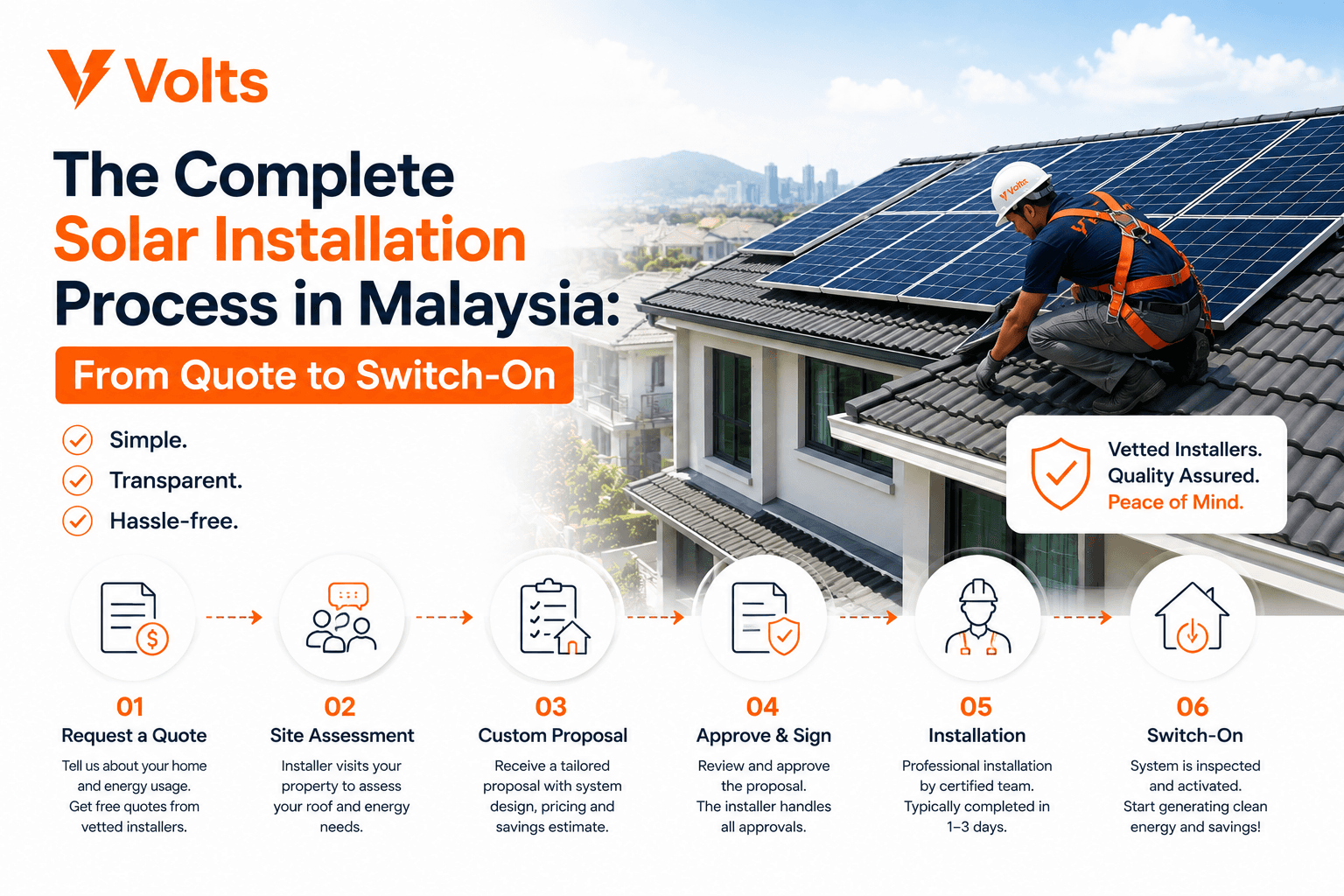
Installing home solar in Malaysia is not just "put panels on roof." It is a structured process involving technical design, paperwork, utility approvals, and staged execution. When you know the timeline upfront, the whole project feels far less stressful.
Key takeaway: Most Malaysian home solar projects take 8-14 weeks end-to-end, with the biggest variation coming from paperwork completeness, roof readiness, and utility scheduling rather than panel installation itself.
This guide breaks down each stage in plain language so you know what happens, how long it takes, and what to ask before signing. If you want a first-pass estimate before speaking to installers, start with the Volts solar calculator.
Typical timeline at a glance (8-14 weeks)
People are often surprised that physical installation is only a small part of the total duration. The approval and coordination steps usually take longer than the on-roof work.
| Stage | Typical duration | What happens |
|---|---|---|
| 1) Quote and site assessment | 1-2 weeks | Bills reviewed, roof checked, system proposed |
| 2) Contract and deposit | 1-5 days | Scope finalized, payment schedule set |
| 3) Engineering + TNB application | 2-5 weeks | Drawings, forms, submission, clarifications |
| 4) Procurement and scheduling | 1-3 weeks | Panels/inverter allocated, install date booked |
| 5) Installation works | 1-3 days | Mounting, wiring, inverter setup |
| 6) Testing + utility/meter steps | 1-3 weeks | Inspections, meter coordination, commissioning |
Total duration varies by installer process maturity, customer responsiveness, and local constraints. A disciplined project manager can reduce avoidable delays significantly.
Stage 1: Quotes and site assessment (Week 1-2)
This is where project quality is set. A good quote is not only a price table, it reflects an actual engineering thought process based on your roof and load profile. If an installer gives a "generic package" without seeing your roof properly, treat that as a warning sign.
Typical inputs requested:
- 6-12 months of TNB bills.
- Roof photos and property type.
- Address and consumption pattern (day vs night use).
- Any constraints such as renovation plans or shaded roof sections.
A proper assessment should cover usable roof area, orientation, potential shading, cable routes, and estimated generation. You should also receive assumptions used in the savings model so you can challenge them if needed.
Questions to ask before accepting a quote
- What system size (kW) is proposed and why this size?
- How much roof area is required and which sections are used?
- What annual generation is estimated and under what assumptions?
- Which panel and inverter models are included?
- What warranties are included for product and workmanship?
If the numbers look too good to be true, they usually are. Cross-check using the Volts calculator and ask installers to explain any big mismatch.
Stage 2: Contract signing and deposit (usually 30%-50%)
After selecting an installer, you sign the agreement and pay an initial deposit. In Malaysia, many residential projects use a 30%-50% deposit structure, with progress payments later. Exact terms vary by installer and project complexity.
Read the payment schedule carefully. The contract should clearly define milestones, not vague dates. You want objective triggers like "after equipment delivery" or "after commissioning."
Contract terms that must be clear
| Contract item | Why it matters |
|---|---|
| Final system size and equipment model | Prevents silent downgrades |
| Total price including hidden costs | Avoids surprise variation orders |
| Scope boundaries (roof repairs excluded?) | Defines who pays if issues appear |
| Approval responsibilities (TNB docs) | Prevents finger-pointing delays |
| Delay handling and reschedule terms | Sets expectations if timeline shifts |
| Defect rectification process | Faster support when faults appear |
Do not rush this stage because sales pressure says "promo ending soon." A good installer will still let you review terms calmly.
Stage 3: Engineering documentation and TNB application (Week 2-7)
This stage feels invisible to homeowners but is often the longest. Your installer prepares technical documents, single-line diagrams, and supporting forms for submission. If details are missing or inconsistent, approvals can bounce back for revision.
For residential NEM participation, documentation quality is critical. Sloppy paperwork creates time loss even when installation quality is good. You should ask for status updates at least weekly during this phase.
What can cause delays here
- Incomplete property or account details.
- Mismatch between proposal and technical drawings.
- Installer backlog in engineering team.
- Clarification requests from utility side.
- Missing signatures or outdated supporting documents.
The best way to avoid delays is speed on your side. Return requested documents quickly and verify your personal details are exact.
Stage 4: Procurement and scheduling (Week 4-9)
Once approvals and internal readiness are in place, your installer confirms equipment and installation date. Popular panel or inverter models can go in and out of stock. This is one reason why two projects with similar size can finish at different times.
Ask whether your exact model is reserved or only "planned." A reserved bill of materials reduces last-minute substitution risk. If substitutions are needed, request written confirmation of equivalent or better specs before accepting.
Practical checklist before installation date
- Roof access route confirmed.
- Any required homeowner/management approval secured.
- No roof renovation work overlapping install window.
- Internet/Wi-Fi plan for inverter monitoring clarified.
- Someone available on site for day-of coordination.
Preparation here prevents wasted site visits and rescheduling fees.
Stage 5: Physical installation (1-3 days)
This is the most visible part and usually the fastest. For typical landed homes, installation often completes in 1-3 days depending on system size, roof complexity, and weather. Rain can pause rooftop works for safety.
Core activities include mounting structure installation, panel placement, DC and AC cabling, inverter installation, and protection devices setup. Good teams keep cable routing neat and secure because long-term reliability depends on workmanship details.
You do not need to supervise every screw, but you should observe professionalism:
- Proper PPE and roof safety practices.
- Clean cable management and labeling.
- Careful handling around roof tiles and waterproofing points.
- Clear explanation before any visible deviations from planned layout.
Take photos during and after install. They are useful records for future maintenance and warranty support.
Stage 6: Meter upgrade, testing, and commissioning (Week 6-14)
After physical installation, the system still needs formal completion flow. This may include testing, handover checks, utility coordination, and meter-related steps depending on your setup and applicable process. Many homeowners mistake "panels installed" for "project complete," but energy crediting readiness depends on this stage.
Commissioning should include system verification and app onboarding. You should receive enough orientation to read your own production data and understand basic alerts.
What handover should include
| Handover item | Why you need it |
|---|---|
| As-built system details | Confirms what was actually installed |
| Warranty certificates | Needed for claims |
| Monitoring app access | Enables monthly performance checks |
| Safety shutdown guidance | Useful in emergencies |
| Maintenance recommendations | Protects long-term output |
If you do not get complete handover documentation, ask before final payment.
Most common reasons projects stretch beyond 14 weeks
Delays are usually operational, not mysterious. Identifying likely bottlenecks early helps you push the right party at the right time.
Top delay causes in Malaysia residential projects:
- Customer-side paperwork or signatures delayed.
- Installer overbooked installation calendar.
- Equipment stock substitutions and re-approval loops.
- Weather interruptions for roof works.
- Utility scheduling windows and holiday periods.
The fix is structured communication. Ask for weekly status updates with "completed / pending / owner" action items.
Questions to ask at each stage (copy this checklist)
During quote stage
- Is this size optimized for my daytime usage and roof constraints?
- What assumptions are used for savings projection?
- What risks could reduce actual performance?
During contract stage
- What exactly triggers each payment milestone?
- Are there additional costs not shown in this quote?
- How are delays handled contractually?
During application stage
- What documents are pending from me now?
- Has submission been accepted, or are revisions required?
- What is the latest expected approval date?
During installation stage
- Is the final layout identical to approved drawings?
- Were there any site deviations, and why?
- What safety checks were completed before energizing?
During commissioning stage
- Is monitoring fully active and tested?
- What should I do if production suddenly drops?
- Who is my support contact and response SLA?
These questions reduce ambiguity and keep everyone accountable.
How payment timing usually works
Payment structures differ, but a common Malaysian residential flow looks like this:
| Milestone | Typical % |
|---|---|
| Contract signing | 30%-50% |
| Post-installation physical completion | 30%-50% |
| Commissioning / final handover | 10%-20% |
Never pay 100% upfront. Healthy installers do not need full prepayment for standard residential jobs.
How to evaluate timeline promises from installers
Some sales teams promise unrealistic completion dates to close quickly. A realistic timeline is detailed and includes dependencies. If an installer claims "3 weeks all done" without caveats, ask them to map each stage.
Good timeline proposals show:
- Named owner for each milestone.
- Estimated duration range, not one rigid date.
- Identified external dependencies.
- Fallback plan if weather or supply shifts.
Transparency beats speed promises.
Malaysia policy context: TNB, SEDA, Solar ATAP
Your installer should be comfortable explaining where your project sits within Malaysia's residential solar ecosystem and utility process. You do not need to become a policy expert, but you should understand the basics of generation, offset, and monitoring under current frameworks.
If these mechanics are still fuzzy, read how solar works before finalizing system size. Understanding daytime generation behavior helps you avoid disappointment later.
Final practical timeline example
To make this concrete, here is a realistic scenario for a landed home:
- Week 1: Site review, bill analysis, three quotes.
- Week 2: Contract signed, 40% deposit paid.
- Week 3-5: Engineering documents and submission flow.
- Week 6: Approval updates received, equipment reserved.
- Week 7: Installation completed in two days.
- Week 8-10: Meter/commissioning coordination, app handover.
- Week 10: Final payment after complete documentation.
This is why "8-14 weeks" is a practical planning range.
Bottom line: process clarity saves money
Most installation stress comes from unclear ownership and vague timelines, not from technical complexity alone. Ask better questions, document every milestone, and keep your own project checklist. That gives you leverage and confidence.
If you are deciding between sizes or installers now, run your numbers first on the Volts calculator. Enter the process with clear expectations, and your solar project will move faster with fewer surprises.
Ready to see your numbers?
Get 3 free quotes from SEDA-verified installers — 100% free for homeowners.
Calculate My Savings