
Solar Panel Maintenance in Malaysia: What You Actually Need to Do
Solar panel maintenance in Malaysia — cleaning schedule, monitoring, annual checks, inverter lifespan, and monsoon tips.
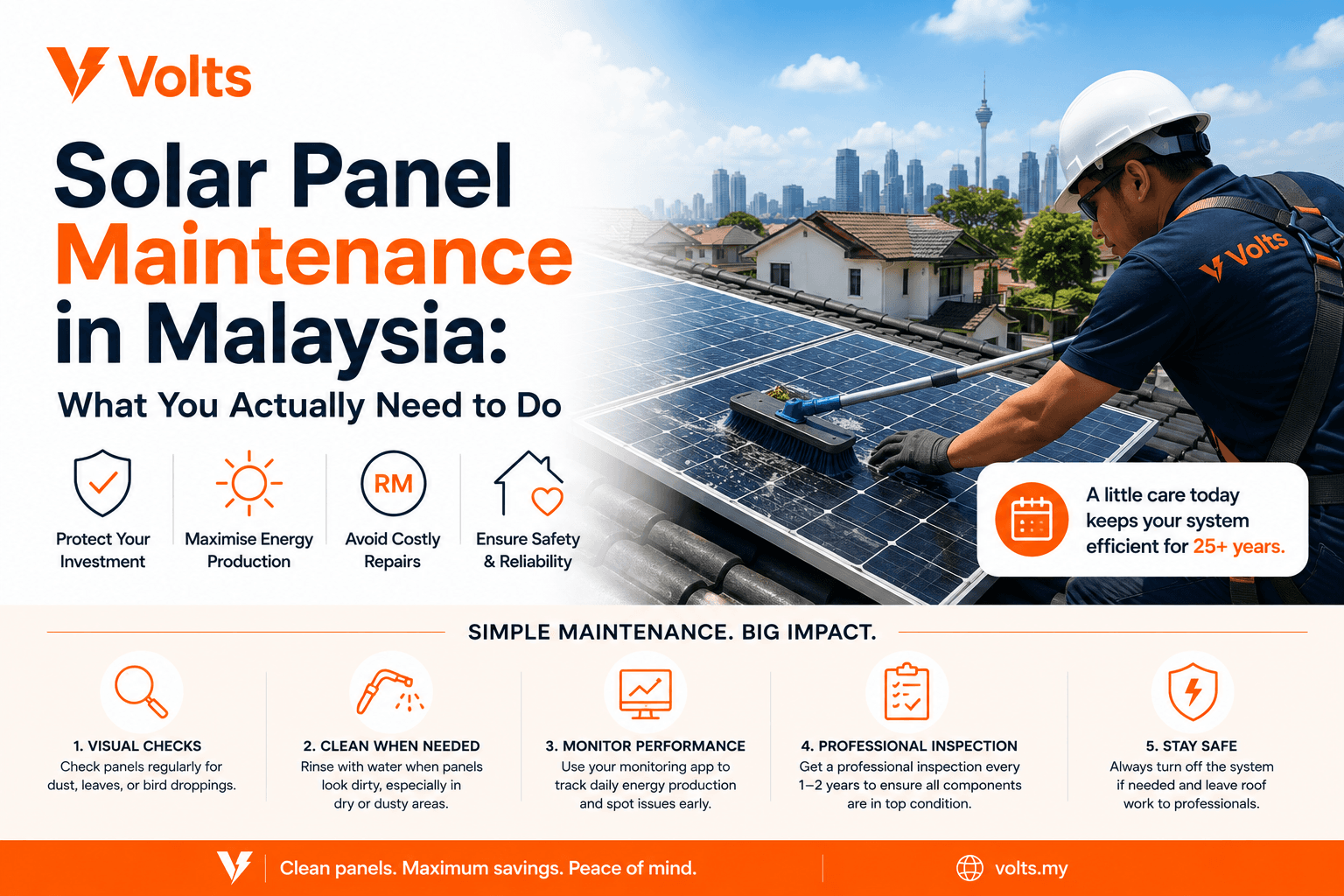
Malaysia homeowners often hear, "Solar is maintenance-free." That is mostly true compared with a car, aircond, or even a water pump. But "low maintenance" and "no maintenance" are not the same thing.
Key takeaway: A good home solar system in Malaysia usually needs light cleaning every 3-6 months, app monitoring every month, and one annual technical check to stay efficient and warranty-safe.
If you ignore your system for years, you can lose production, miss inverter faults, or accidentally void warranty claims. If you maintain it properly, solar stays predictable and boring, which is exactly what you want for a 25-year asset. You can estimate your long-term savings first with the Volts calculator, then use this guide to protect those savings.
The low-maintenance reality in Malaysia
Most residential systems run quietly with minimal intervention. Panels have no moving parts, so there is far less mechanical wear than many people expect. The components that usually need attention are dirt buildup, wiring condition, roof penetrations, and inverter health.
Malaysia's weather is both helpful and challenging. Regular rain can wash loose dust, but sticky grime, bird droppings, and haze particles still build up over time. Monsoon winds can also move debris around your roof and create partial shading.
The practical mindset is simple: check often, intervene lightly, and fix early. Small actions prevent expensive surprises. That is the difference between a system that underperforms at year 5 and one that still delivers strong output at year 20.
What actually needs maintenance
For most homes, maintenance is about five areas. You can handle some tasks yourself, while licensed professionals should do electrical and safety-critical checks.
| Area | Typical frequency | Who handles it | Why it matters |
|---|---|---|---|
| Surface cleaning | Every 3-6 months | Homeowner or service team | Restores output lost to dirt and droppings |
| App monitoring | Monthly | Homeowner | Detects faults and abnormal drops quickly |
| Visual roof check | After storms + quarterly | Homeowner | Finds loose debris, shading, obvious damage |
| Electrical + mounting inspection | Annually | Qualified technician | Prevents safety risk and hidden failures |
| Inverter performance review | Annually + alerts | Installer/service partner | Inverter is the most failure-prone component |
A proper installer usually provides a maintenance schedule when handing over the system. If they did not, request one in writing. This also helps if you need a warranty claim later.
Cleaning panels every 3-6 months: what is enough
In urban and suburban Malaysia, 3-6 months is a realistic cleaning interval. If you live near heavy traffic, construction, farms, or industrial zones, clean closer to every 3 months. If your roof is steep, inaccessible, or unsafe, use a professional service.
Do not over-clean. Aggressive scrubbing can micro-scratch glass and reduce performance over years. The goal is gentle removal of stubborn dirt, not making panels look showroom-new.
Safe cleaning method
- Clean early morning or late evening when panels are cool.
- Use soft water and a non-abrasive sponge or soft-bristle brush.
- Avoid harsh detergents, bleach, pressure jets, or metal tools.
- Never step directly on panels.
- Prioritize safety if your roof is high, wet, or steep.
Rain helps, but rain alone rarely removes sticky grime and bird droppings. A simple cleaning routine can recover noticeable production, especially on systems with shallow roof tilt.
Monthly monitoring through your inverter app
Your inverter app is the easiest maintenance tool you have. Spend 5-10 minutes monthly checking generation trends, not just one-day numbers. The best signal is "this month versus similar months last year," adjusted for weather.
Focus on three indicators:
- Daily kWh trend: sudden persistent drops need investigation.
- Fault codes or warnings: do not ignore recurring alarms.
- String mismatch (if shown): one string producing much less may indicate shading, dirt, or wiring issue.
If your app stops reporting data, do not assume only Wi-Fi is down. Communication errors sometimes hide inverter issues. Report it quickly to your installer and keep screenshots for records.
Annual checklist: what to inspect professionally
A yearly technical inspection is the sweet spot for most homes. It is affordable and catches issues before they become major failures. Ask for a service report after each visit.
| Annual item | What technician checks | Typical issue caught |
|---|---|---|
| DC/AC connectors | Tightness, corrosion, heat marks | Loose connector causing heat and losses |
| Cabling and conduit | UV damage, cracks, rodent bites | Insulation degradation, safety risk |
| Mounting rails and clamps | Torque, rust, movement | Mechanical loosening after storms |
| Roof penetrations | Sealant integrity and leaks | Water ingress and ceiling damage |
| Inverter condition | Error logs, fan status, temperature | Early inverter wear |
| Earthing and surge protection | Continuity and protection health | Increased lightning-related risk |
Malaysia's humidity and heat accelerate aging of weak materials. This is why installer quality matters more than brochure claims. Good hardware + proper workmanship reduces long-term maintenance stress.
Shading: the silent output killer
A system can be electrically healthy but still underperform due to new shading. Trees grow, nearby renovations add structures, and rooftop equipment gets moved over time. Even partial shade on one section can drag down output for a whole string on older designs.
Watch for gradual production decline that cannot be explained by weather. If your app supports panel-level or string-level data, compare sections. If shading increased, trimming foliage or revising panel layout may recover output.
Common Malaysia shading sources include:
- Fast-growing trees in landed neighborhoods.
- Water tanks, satellite dishes, and roof extensions.
- Adjacent construction in dense terrace rows.
- Debris accumulation after monsoon storms.
Inverter lifespan and replacement cost (10-15 years)
Panels often have 25-year performance warranties, but inverters usually have shorter service life. For many homes, inverter replacement is expected around year 10-15. This is normal lifecycle planning, not system failure.
For typical residential sizes, inverter replacement in Malaysia often ranges around RM2,000-RM5,000, depending on brand, capacity, warranty, and whether rewiring/upgrades are needed. Premium hybrid or battery-ready models can cost more.
Plan for this early. If you model savings without future inverter replacement, your ROI estimate is too optimistic. A realistic long-term plan includes one inverter budget event.
Degradation is real but manageable: 0.5%-0.7% per year
Solar panels naturally degrade over time. In Malaysia, a practical planning range is around 0.5%-0.7% output decline per year for mainstream modules, assuming proper installation and maintenance. That means production drops gradually, not suddenly.
This degradation does not make solar "bad." It is already priced into bankable energy models and manufacturer warranties. What hurts more than normal degradation is preventable loss from dirt, shading, and unresolved faults.
If your system drops much faster than expected, request a performance investigation. Keep monthly generation records to support warranty discussions.
Warranty mistakes that can void claims
Many homeowners accidentally weaken their warranty position. Warranty disputes often fail because documentation is missing or unauthorized work was done. Read your warranty terms before a problem happens.
Common risk points:
- Unlicensed third-party rewiring or modifications.
- Roof work that disturbs mounting without solar re-check.
- Cleaning with prohibited chemicals or tools.
- Ignoring recurring fault alerts for long periods.
- No proof of commissioning documents or maintenance logs.
Keep a simple digital folder with contracts, single-line diagrams, commissioning photos, and service reports. If an issue occurs, this file can save weeks of back-and-forth.
Malaysia-specific weather: monsoon and haze
Monsoon season
Heavy rain and wind can shift debris and increase risk of blocked drainage near panels. Post-storm visual checks are useful: look for leaves, branches, or obvious loose elements. If you suspect water ingress, contact your installer quickly before ceiling damage worsens.
Haze periods
Fine particulate haze can leave stubborn film that rain does not fully remove. During prolonged haze, cleaning frequency may need to shift from 6 months to 3 months. Monitor output trend and use data, not guesswork.
High heat and humidity
Malaysia's hot, humid climate stresses electronics more than panel glass. Inverter ventilation and placement matter. Installers should avoid poorly ventilated spots with trapped heat.
Should you DIY or hire a service plan?
DIY works for easy-access roofs and basic app checks. Professional maintenance is better when your roof is steep, high, or has limited safe access. Safety and warranty protection matter more than saving a few hundred ringgit once.
Many homeowners use a hybrid approach:
- DIY app monitoring monthly.
- DIY visual checks from safe vantage points.
- Professional cleaning and annual technical inspection.
This gives you low cost and high reliability without unnecessary risk.
Typical maintenance budget to expect
Maintenance cost varies by roof difficulty and service scope. Most homes do not face large recurring bills every year, but budgeting prevents surprises.
| Cost item | Typical range (RM) | Frequency |
|---|---|---|
| Basic cleaning visit | 150-400 | Every 3-6 months (if outsourced) |
| Annual technical inspection | 300-800 | Yearly |
| Minor corrective work | 200-1,200 | As needed |
| Inverter replacement | 2,000-5,000 | Around year 10-15 |
If your installer includes early-year servicing in package warranty, use it. Still monitor your own data so problems are detected between scheduled visits.
Maintenance and policy context: TNB, SEDA, Solar ATAP
Under Malaysia's NEM framework and Solar ATAP ecosystem, generation data and proper commissioning records are important for clean operations over time. Maintenance does not change your core NEM mechanics, but it directly affects the amount of kWh you export or offset. Lower performance means lower real savings even if your paperwork is fine.
If you are still evaluating system size, use your bill profile first at the Volts solar calculator. If you need a quick refresher on NEM flow, credits, and why daytime generation pattern matters, read how solar works in Malaysia.
A practical maintenance routine you can start now
You do not need an elaborate spreadsheet. Use a simple calendar and one cloud folder.
Monthly (10 minutes):
- Check app production trend and alerts.
- Confirm inverter remains online.
- Save screenshots if anything looks odd.
Quarterly:
- Visual roof scan after heavy rain or wind.
- Identify new shading from trees or structures.
Every 3-6 months:
- Clean panels safely or book professional cleaning.
Yearly:
- Book full technical inspection and keep the report.
This routine keeps your system efficient, protects your warranty, and reduces long-term cost anxiety.
Final word: low effort, high discipline
Solar maintenance in Malaysia is not complicated, but it does require consistency. Most homeowners who run into avoidable losses did not fail because solar is hard, they failed because they stopped checking. A small routine beats expensive troubleshooting later.
If your monthly TNB bill is still high or your system seems under-sized, run updated numbers at the Volts calculator. The best maintenance strategy starts with a system sized correctly from day one.
Ready to see your numbers?
Get 3 free quotes from SEDA-verified installers — 100% free for homeowners.
Calculate My Savings