
Solar Panels for Terrace Houses in Malaysia: Everything You Need to Know
Solar for terrace houses in Malaysia — roof space, orientation, party wall rules, costs, and a real Subang Jaya example.
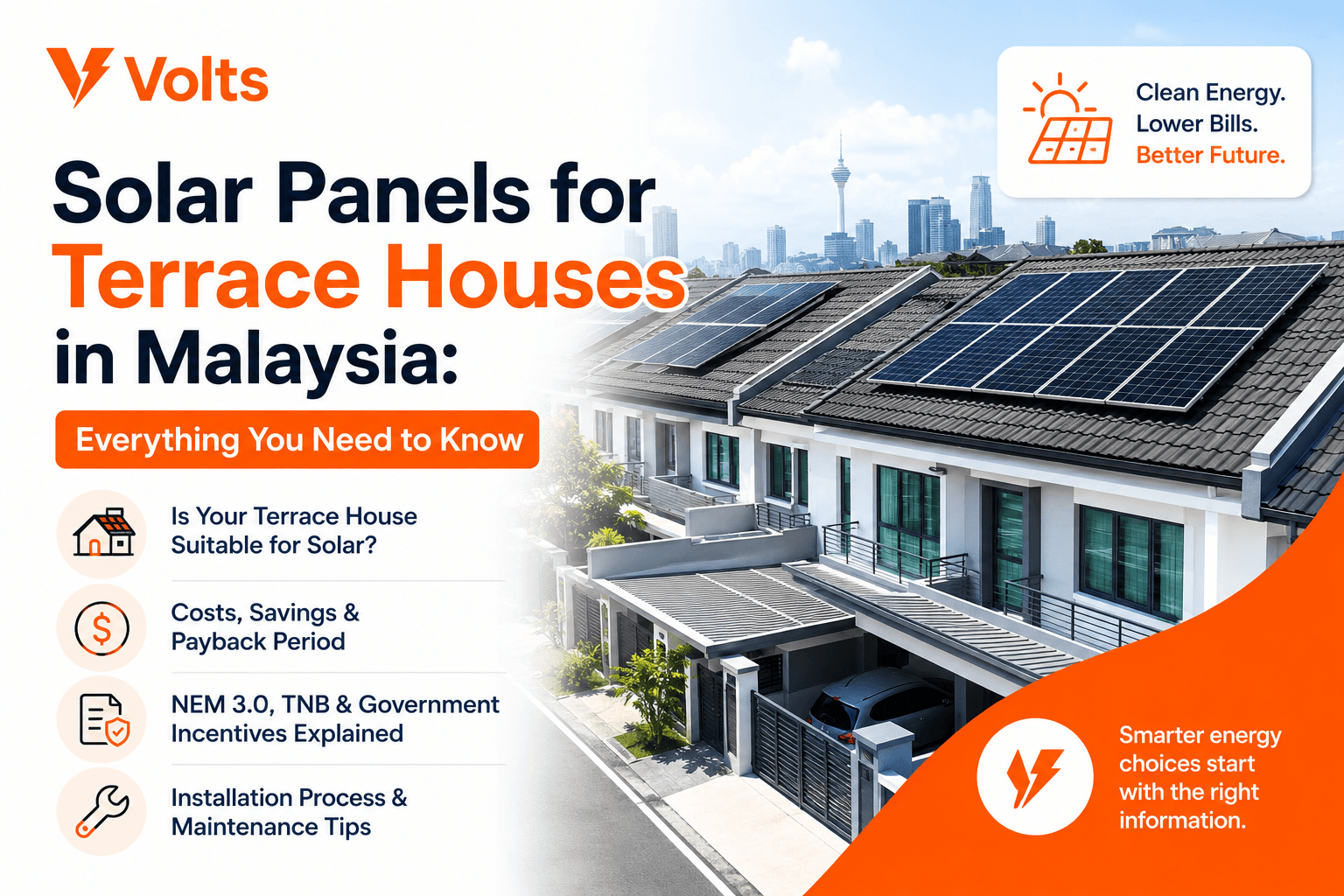
Terrace houses are one of the most common property types in Malaysia, so this is one of the most common questions: can terrace homes get good solar returns? In many cases, yes. The result depends on roof usability, shading, and installer design quality.
Key takeaway: Many Malaysian terrace houses can support 5-8kW systems with strong economics, provided you have enough usable roof area, manageable shading, and proper approval/documentation.
If you are comparing size and savings now, start with your bill data in the Volts calculator. Then use this guide to understand what makes terrace projects succeed or fail.
Are terrace houses suitable for solar?
Most terrace homes are suitable, but not all are equally straightforward. The biggest advantage is predictable roof geometry compared with many complex bungalow designs. The biggest constraints are shared urban density, shading from neighboring structures, and management or street-level expectations in gated neighborhoods.
Suitability usually depends on these factors:
- Available unshaded roof area.
- Roof orientation and pitch.
- Roof structural condition and waterproofing health.
- Access for installation and future maintenance.
- Local approval constraints if in managed communities.
Do not assume your neighbor's result applies directly to your roof. Even houses on the same row can have different shading patterns.
Usable roof area: why 800-1,200 sqft is a practical range
For many double-storey terrace homes, total roof footprint may be decent, but not all of it is usable for solar modules. Obstructions, walkways, setbacks, ridge spacing, and shaded sections reduce installable area. A practical usable range often falls around 800-1,200 sqft, though exact values vary by design.
You should ask for a layout that marks:
- Installable area.
- Excluded zones and reasons (shade, access, safety spacing).
- Estimated module count and final kW.
This avoids over-promised system sizes that shrink later during engineering.
Typical system size for terrace homes: 5kW to 8kW
For many terrace households, 5-8kW is a common sweet spot. It usually aligns with medium to higher TNB consumption and typical roof constraints. Smaller systems can still work, but may leave savings on the table for higher-usage families.
Rough sizing guidance
| Household profile | Typical bill range | Common system size |
|---|---|---|
| Moderate use | RM180-RM300 | 4-6kW |
| Higher use | RM300-RM500 | 5-8kW |
| Heavy daytime use | RM500+ | 7-10kW (if roof allows) |
These are planning ranges, not guarantees. Actual sizing should follow your daytime usage and roof-specific constraints.
Orientation matters: North-South vs East-West
Roof orientation affects generation curve and total annual output. In Malaysia, both North-South and East-West can be workable, but they behave differently. The right choice is often tied to your load pattern, not only maximum annual kWh.
North-South orientation
Generally preferred when available because it can produce stronger annual performance under many conditions. This can improve long-term savings if shading is minimal. It is often the first choice in clean, open roof conditions.
East-West orientation
Very common in terrace rows where roof direction is fixed. It can still perform well, often with smoother morning-to-evening generation spread. For households with usage in both morning and late afternoon, this can align reasonably with demand.
The wrong move is forcing a "best orientation" narrative while ignoring actual shading and roof geometry.
Terrace-specific shading risks
Terrace neighborhoods are dense, and shading can change over time. Trees grow, new awnings appear, and nearby renovations alter sun access. Even modest shade on one part of the system can reduce output materially on older string configurations.
Common terrace shading sources:
- Neighbor roof extensions and rooftop structures.
- Water tanks and satellite dishes.
- Fast-growing roadside trees.
- Rear-lane structures and utility poles in some layouts.
A good installer should run a shade-aware design, not just maximize panel count.
Party wall and shared-boundary considerations
Terrace properties often involve proximity to shared walls and closely spaced roofs. While solar panels usually remain on your own roof area, installation logistics may involve temporary access and careful coordination to avoid disputes.
Practical tips:
- Inform adjacent neighbors before installation dates.
- Ensure no equipment overhangs beyond your legal boundary.
- Keep cable routes and conduits tidy and non-intrusive.
- Request installer method statement if your area is sensitive.
Clear communication avoids unnecessary friction.
Gated community and management approvals
If your terrace home is in a guarded or managed township, you may need community-level approvals or contractor registration before work starts. Rules vary widely by management body and developer legacy conditions.
Typical requirements can include:
- Work permit or renovation form.
- Contractor worker registration.
- Deposit for common area protection.
- Restricted working hours or vehicle access limits.
If you ignore this early, your installation date can slip even when all technical paperwork is ready.
Terrace vs semi-D vs link houses: practical differences
Terrace
Usually more constrained by shared urban context and fixed roof geometry. Strong ROI is still possible, but detailed layout discipline is crucial.
Link-semi-D
Often offers slightly more roof flexibility and lower shading pressure than inner-row terrace units. Installation logistics can be easier.
Semi-D / detached
Typically offers the most area flexibility and custom layout options, but not automatically better ROI. Large roof does not guarantee better economics if usage profile is low.
In short, terrace is not "worse," it just needs tighter design and approval planning.
Roof condition check before installation
Do not install solar on a roof that is near major repair cycle. Removing and reinstalling panels later can add avoidable cost and downtime. A roof condition check should be part of pre-contract due diligence.
Look for:
- Existing leaks or past patchwork history.
- Broken or brittle tiles/metal sections.
- Sagging indications or structural concerns.
- Poorly maintained waterproofing around penetrations.
If roof rehabilitation is needed, do it first, then install solar.
Cost reality: RM20,000-RM28,000 for 5kW
A common question for terrace homes is budget. For many standard residential setups, a 5kW system often falls around RM20,000-RM28,000 depending on hardware tier, roof complexity, warranty scope, and installer reputation.
Cheaper quotes can exist, but compare scope carefully. Differences often come from component tier, workmanship scope, and after-sales commitments.
| 5kW quote scenario | Estimated price (RM) | Typical trade-off |
|---|---|---|
| Budget package | 20,000-22,000 | Lower-tier components or thinner support |
| Mid-range balanced | 23,000-26,000 | Better reliability/support balance |
| Premium package | 26,000-28,000+ | Higher-end components, longer support terms |
The right choice depends on risk tolerance, not only lowest upfront cost.
Subang Jaya-style example: RM380 bill to around RM60
Consider a terrace household in a high-usage suburban profile:
- Average monthly bill before solar: RM380
- System size: around 5-6kW
- Usage pattern includes daytime appliance load
- Roof has manageable shading after tree trimming
In favorable conditions, households like this can see dramatic bill reductions, sometimes to around RM60 in good production months. Actual outcomes vary by weather, tariff structure, and behavior, but this illustrates why terrace solar remains compelling for many families.
The important point is not the exact RM60 figure. The point is that right-sized systems on suitable terraces can materially shift monthly cash flow.
How to avoid over-sizing in terrace projects
More kW is not always better if your roof sections are suboptimal. Over-sizing into shaded or poor-orientation zones can worsen returns for the last kW installed. Good design balances usable area, production quality, and budget.
A disciplined approach:
- Size core system on best roof zones first.
- Model marginal benefit of additional panels.
- Stop expansion when added kWh value weakens materially.
This is especially important on terrace roofs where prime area is limited.
Maintenance expectations for terrace homes
Terrace systems are generally low maintenance, but urban dust and haze can justify cleaning every 3-6 months. App monitoring monthly is still essential to detect early performance drops. Annual professional checks protect reliability and warranty confidence.
Terrace-specific note: nearby trees and urban debris can change quickly after monsoon periods. A post-storm visual check is simple and worthwhile.
Policy and utility context: TNB, SEDA, Solar ATAP
Your terrace-home economics are shaped by system performance and your consumption profile under Malaysia's operating framework. Administrative completeness still matters, but practical savings come from real kWh generation and offset quality over time.
If you need a refresher on how credits and daytime generation interact, read how solar works. Understanding this prevents unrealistic expectations from sales slides.
Questions terrace homeowners should ask installers
Use this list before signing:
- How much of my roof is truly usable after exclusions?
- Which areas are shaded seasonally and how is that modeled?
- What is the expected output range, not just one number?
- Are there gated-community or management requirements to clear first?
- What happens if roof defects are found during install?
- What are the exact warranties for products and workmanship?
- What maintenance schedule do you recommend for my location?
If answers are vague, request written clarification.
Red flags specific to terrace projects
Be careful if you see any of these:
- Installer ignores shade discussion and only pushes bigger kW.
- Quote has no detailed layout or roof photos.
- No mention of management approval despite gated context.
- Pricing is far below market with unclear component specs.
- Support process after commissioning is undefined.
Terrace projects can be excellent, but shortcuts are visible quickly.
Practical decision flow for terrace owners
| Step | Action | Output |
|---|---|---|
| 1 | Collect 6-12 months bills | Baseline usage profile |
| 2 | Shortlist 3 installers | Better benchmark and negotiation |
| 3 | Request roof-specific layout | Realistic size and shading view |
| 4 | Compare total scope apples-to-apples | True value, not fake cheap |
| 5 | Verify approvals and timeline | Fewer execution surprises |
| 6 | Sign with clear milestones | Better project control |
This process is simple and highly effective.
Bottom line for Malaysian terrace houses
Terrace houses are often very viable for solar, and many homeowners see meaningful monthly savings when systems are designed correctly. The typical 5-8kW range fits many real households, and 5kW pricing in the RM20,000-RM28,000 range can still make financial sense depending on usage profile.
Success depends on usable roof area, shading control, approval readiness, and installer quality. If you want a quick estimate tailored to your bill profile, run the Volts calculator first and use this guide as your project checklist.
Ready to see your numbers?
Get 3 free quotes from SEDA-verified installers — 100% free for homeowners.
Calculate My Savings