
Does Solar Work in Malaysia's Rainy Season? (The Myth Everyone Still Believes)
"Malaysia has too much rain for solar" is still heard at every family gathering. Here is what actually happens to your panels through monsoon season.
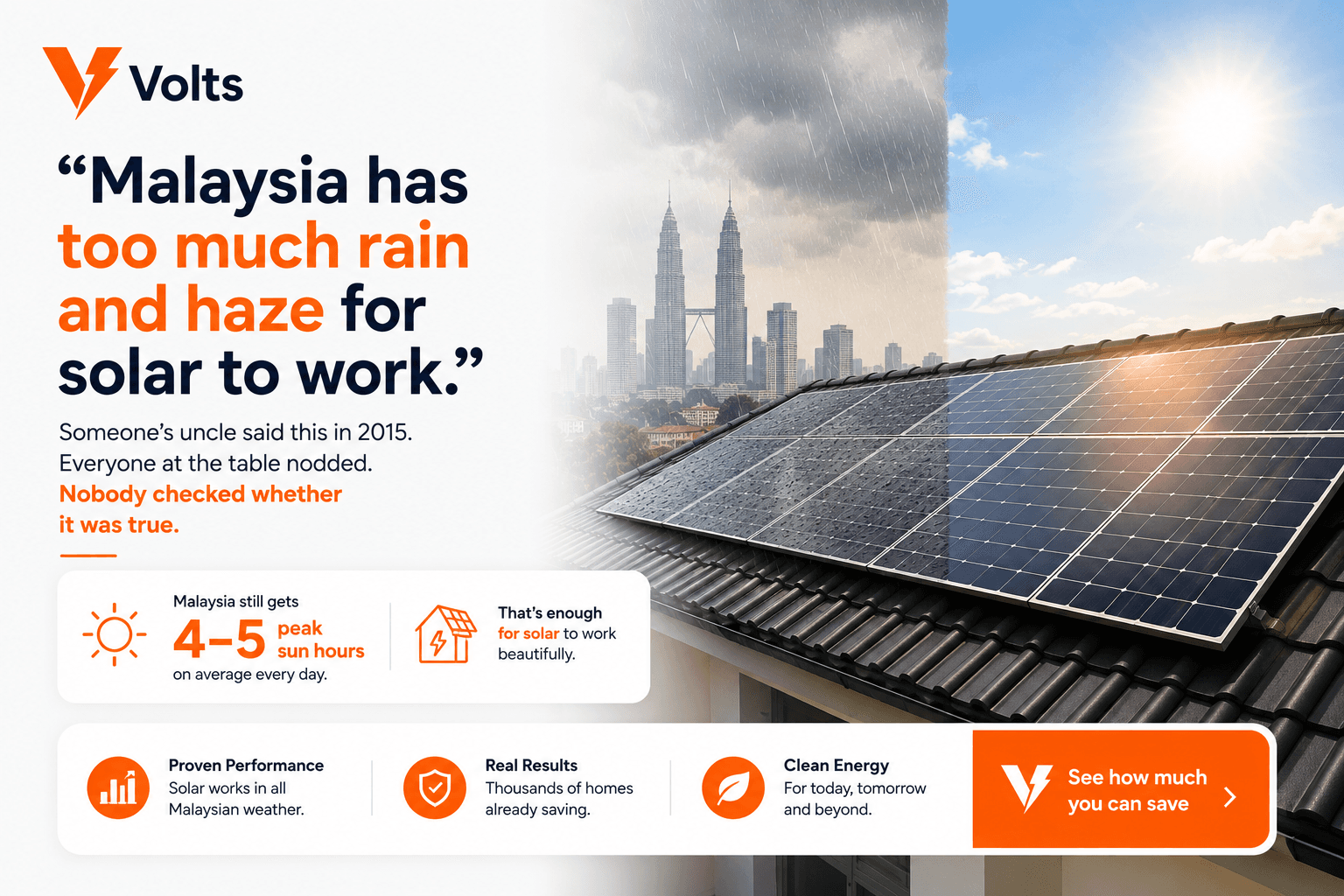
"Malaysia has too much rain and haze for solar to work."
Someone's uncle said this in 2015. Everyone at the table nodded. Nobody checked whether it was true.
Meanwhile, your neighbour's panels have been quietly cutting his TNB bill through three monsoon seasons — and he has not thought about the uncle's opinion once.
Key takeaway: Solar panels do not need direct blazing sun all day to produce power. They need light. Malaysia's equatorial climate delivers plenty of that, year-round — including during rainy season.
Where the myth comes from
The confusion is understandable. People conflate two different things:
- Peak output on a cloudless afternoon (when panels hit their highest numbers)
- Total energy production across the year (what actually determines your savings)
Rainy days reduce peak output. They do not zero it out.
Modern panels still generate electricity under overcast skies — just at a lower rate. And Malaysia's weather pattern means heavy rain often clears quickly, followed by strong afternoon sun that panels absorb immediately.
What actually happens during monsoon season
Here is the honest breakdown:
Cloud cover reduces output, not eliminates it
On a fully overcast day, panels might produce 20–40% of their clear-sky capacity. That is still meaningful generation across a full day — especially when your home is running fridges, routers, fans, and daytime appliances anyway.
Rain helps more than it hurts
Rain naturally washes dust and grime off panel surfaces. In Malaysia's humid, dusty environment, a good downpour can actually improve efficiency for the days that follow. Less manual cleaning, better light absorption.
Temperature matters more than people think
Panels actually perform worse in extreme heat than in moderate temperatures. Malaysia's tropical climate keeps panels warm, but frequent cloud cover and rain cycles can moderate surface temperature — sometimes improving real-world output compared to a hot, stagnant afternoon.
Annual yield is what counts
Installers size systems based on yearly production estimates, not a single perfect sunny week. Malaysian solar yield data consistently supports viable residential systems across Peninsular Malaysia, Sabah, and Sarawak — including East Coast monsoon zones.
The haze question
Haze is a separate concern, and it is real — prolonged haze events do reduce irradiance. But they are seasonal and temporary. System sizing and payback calculations account for average annual conditions, not worst-case weeks.
If haze were a dealbreaker, the tens of thousands of residential and commercial solar installations already operating across Malaysia would not exist. They do — and their owners are still receiving TNB bill reductions.
What your neighbour already knows
That neighbour with panels on his roof? Check his bill trend across wet months. You will likely find:
- Bills still drop compared to pre-solar baselines
- Production dips on extended rain weeks, but recovers quickly
- He is not removing the system every November
Solar is not a fair-weather hobby. It is infrastructure — designed, installed, and warranted for Malaysia's actual climate, not an idealised desert.
Get numbers for your roof, not your uncle's opinion
Family advice is free. Good data is better.
Before dismissing solar based on a decade-old myth, see what your specific roof, bill, and location actually produce. A terrace in Johor behaves differently from a bungalow in Penang — but neither is disqualified by rain alone.
Get the real numbers for your roof — volts.my/calculator. Free, takes a few minutes, and no uncle required.
Ready to see your numbers?
Submit a verified solar enquiry and get free quotes from SEDA-verified installers, 100% free for homeowners.
Calculate My Savings