
Solar Roof Orientation in Malaysia: Which Direction Gets the Most Sun?
North, east, or west? Which roof direction works best for solar in Malaysia? Tilt angles, shading, and how orientation affects your system size and savings.
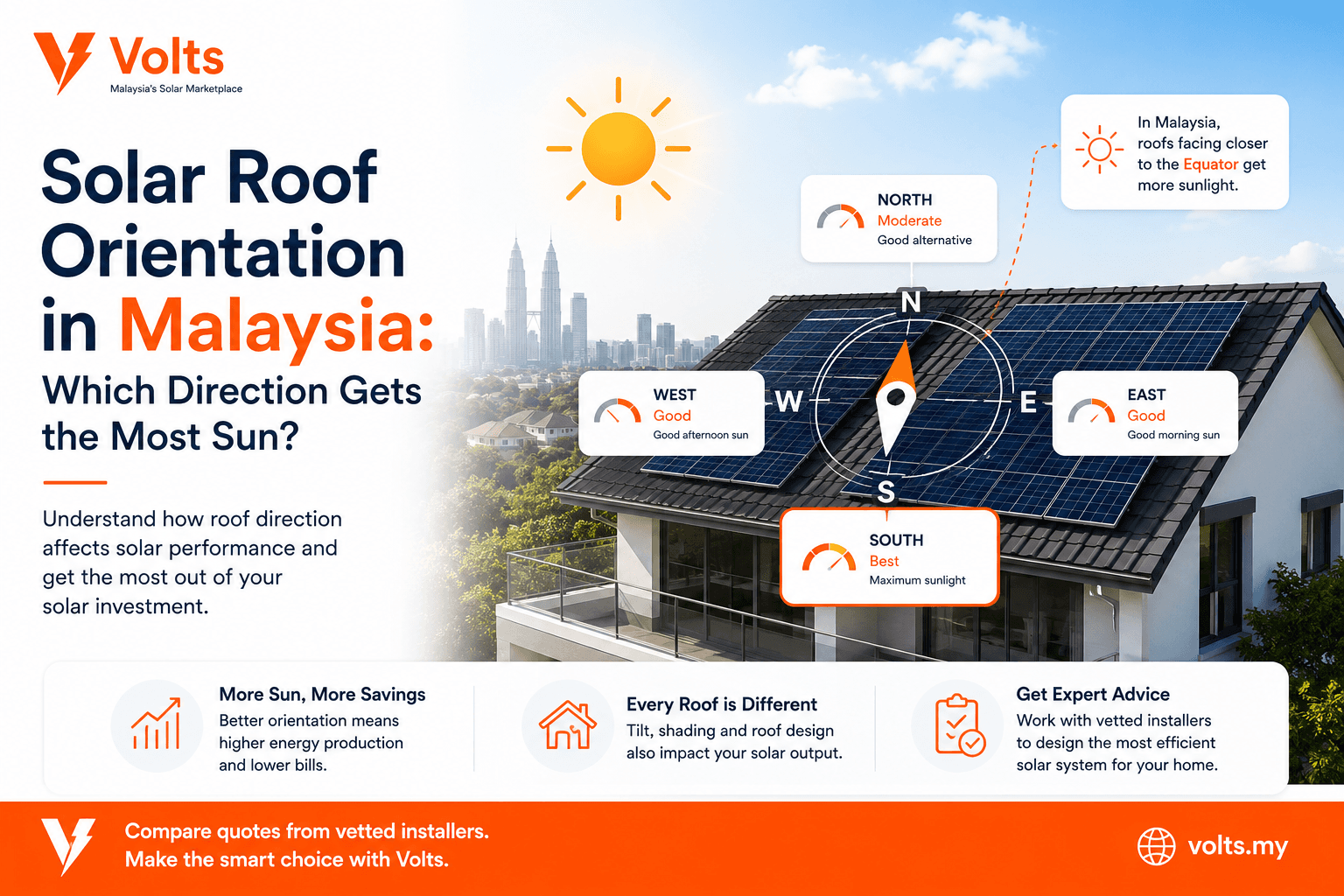
Malaysia sits near the equator, so solar panels behave differently here than in Europe or Australia. Homeowners often ask whether their north-facing roof is "wrong" or if an east-west layout is worth considering. The answer depends on your roof geometry, shade patterns, and when you use electricity.
Key takeaway: In Peninsular Malaysia, north-facing roofs generally produce the highest annual yield. East and west orientations still work well — often within 85–95% of north-facing output. South-facing sections are rare and usually perform similarly to north. Shade matters more than a few degrees of orientation on most residential roofs.
Use the Volts calculator with your actual bill data before assuming your roof is unsuitable.
Why orientation matters (but is not everything)
Solar panels produce power when sunlight hits the cell surface. The amount of energy depends on:
- Direction the roof faces (azimuth).
- Tilt angle relative to horizontal.
- Shade from trees, neighbouring buildings, water tanks, and parapet walls.
- When you consume electricity — morning-heavy vs afternoon-heavy usage.
Orientation affects total annual kWh. It does not change whether solar works in Malaysia — it changes how large your system needs to be to hit the same savings target.
Best roof directions in Malaysia
Because Malaysia is in the northern hemisphere (just above the equator), the sun tracks mostly through the southern sky during the day.
| Roof direction | Typical annual performance vs best case | Peak production time |
|---|---|---|
| North-facing | 100% (baseline) | Midday (11 a.m. – 2 p.m.) |
| East-facing | 85–92% | Morning (8 a.m. – 11 a.m.) |
| West-facing | 85–92% | Afternoon (2 p.m. – 5 p.m.) |
| South-facing | ~95–100% | Midday (similar to north) |
| Flat roof (optimal tilt added) | 90–98% | Midday |
These are indicative ranges. Actual performance depends on tilt, shade, and local weather.
North-facing: the default sweet spot
Most Malaysian terrace and semi-D homes have a long roof plane facing roughly north. This is ideal for even, midday-heavy production — which suits households with daytime usage (stay-at-home family, home office, aircon running through the afternoon).
East-west: not a dealbreaker
If your usable roof faces east and west (common on corner lots or certain semi-D designs), installers often split the array across both planes. You lose some peak midday output but gain longer production spread across the day.
That can actually help if your family uses more power in the morning (east) and evening (west) than at noon. An experienced installer will model this before recommending string vs microinverter layout.
South-facing sections
True south-facing roof area is uncommon in standard terrace layouts. Where it exists, performance is typically strong — comparable to north. Do not avoid a south section thinking it is "wrong" for Malaysia.
Tilt angle: what works on Malaysian roofs
Most pitched residential roofs in Malaysia sit at 25–35 degrees, which is close to optimal for year-round production at our latitude (~2–7°N).
| Roof type | Typical tilt | Solar implication |
|---|---|---|
| Standard pitched terrace/semi-D | 25–35° | Usually excellent — no tilt modification needed |
| Low-slope roof | 10–20° | Slightly lower yield; may need more panels for same kWh |
| Flat roof (common on condo/commercial) | 0° (flat) | Requires tilt frames (10–15° typical) for drainage and output |
| High-pitch heritage-style | 35°+ | Still workable; wind loading becomes a design factor |
Flat roofs need tilt mounting frames — panels should not lie flat for both performance and rainwater runoff. Budget for the extra racking if you have a flat or low-slope roof.
Shade: the silent production killer
A partially shaded north-facing roof often produces less than an unshaded east- or west-facing roof. Shade is the factor most homeowners underestimate.
Common shade sources in Malaysia
- Neighbouring terrace roofs and party walls.
- Mature rain trees and palm trees (especially afternoon west shade).
- Water tanks, TV antennas, and solar water heaters on the roof.
- Parapet walls on flat-roof sections.
- New developments — a cleared site today may be shaded in three years.
What to do before quoting
- Take roof photos at 9 a.m., 12 p.m., and 4 p.m. on a sunny day.
- Ask installers for a shade analysis (many use software like PVsyst or Helioscope).
- If shade is unavoidable on part of the roof, ask about microinverters or power optimisers — string inverters perform poorly under partial shade.
We cover inverter choices in detail in our inverter types guide. The short version: do not put a heavily shaded array on a basic string inverter without understanding the output penalty.
Matching orientation to your usage pattern
Annual kWh is not the only metric. When power is produced matters for self-consumption vs export.
| Your usage pattern | Favoured orientation |
|---|---|
| High daytime use (WFH, retirees, young children at home) | North or any — self-consumption captures most value |
| Empty house 9–5, heavy evening use | East-west split can align better with morning/evening loads |
| Mostly night usage | Orientation matters less — you will export more regardless; net metering credits become important |
Under net metering, exported power still earns bill credits — so moderate orientation differences rarely kill project viability. They mainly affect how many panels you need for the same target offset.
Worked example: same house, different orientations
Assume a terrace in Petaling Jaya, 5 kW system, minimal shade:
| Orientation | Est. annual production | Est. annual savings (blended) |
|---|---|---|
| North-facing 5 kW | ~6,500 kWh | ~RM 1,750 |
| East-facing 5 kW | ~5,900 kWh | ~RM 1,590 |
| West-facing 5 kW | ~5,850 kWh | ~RM 1,575 |
| North-facing but 20% shaded | ~5,200 kWh | ~RM 1,400 |
The shaded north roof underperforms the unshaded east roof. This is why site assessment beats compass direction alone.
What to tell your installer
Be specific about your roof:
- Which roof planes are available (north, east, west)?
- Are any sections blocked by tanks, structures, or trees?
- Is the roof tile, metal deck, or concrete slab?
- Any planned extensions or neighbour construction nearby?
Ask for estimated monthly production by month — Malaysia's monsoon months (Nov–Jan) produce noticeably less than dry-season months. Seasonal variation is normal; a good proposal acknowledges it.
Common myths
"My roof faces the wrong way for solar."
Very few Malaysian roofs are truly unsuitable. East, west, and north all work. Only heavy, persistent shade makes a roof a poor candidate.
"I need to change my roof direction."
Never. Installers work with available planes. Split-array designs are standard.
"Flat roof means no solar."
Flat roofs are common on commercial and some residential buildings. Tilt frames solve the angle issue.
Bottom line
Roof orientation affects system sizing and production timing, but it rarely disqualifies a Malaysian home from solar. North is best on paper; east and west are close behind; shade is the factor that should worry you more.
Get a proper shade assessment, match the design to your usage pattern, and compare quotes on expected kWh, not just panel count. Start with your numbers on the Volts calculator, then request proposals that explain orientation assumptions clearly.
Ready to see your numbers?
Get 3 free quotes from SEDA-verified installers — 100% free for homeowners.
Calculate My Savings