
TNB Net Metering Explained: How to Sell Your Excess Solar Energy Back
How TNB net metering works in Malaysia — export rates, bidirectional meters, bill credits, and what homeowners get wrong.
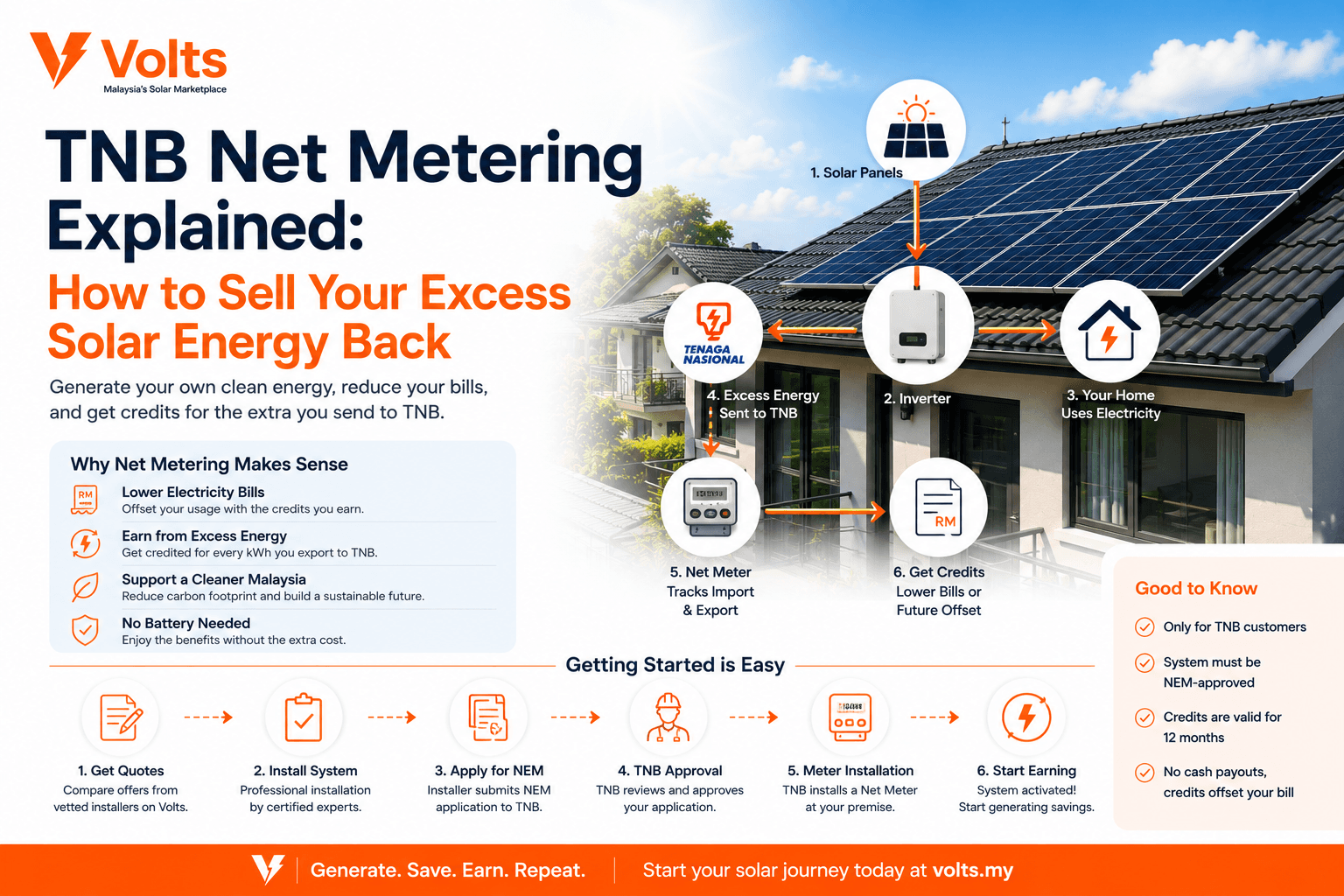
Net metering sounds technical, but the core idea is simple. Your home uses solar power first, and any extra can flow back to the grid through a bidirectional meter.
Key takeaway: Net metering helps reduce your TNB bill, but it rewards smart sizing and daytime self-consumption more than heavy export. Think of export as a useful offset feature, not a business model.
Many homeowners only understand this after they install. If you learn it earlier, you can avoid oversizing mistakes and unrealistic savings expectations.
Net metering in plain language
Under net metering, your rooftop system generates electricity during daylight hours. Your home consumes what it needs first, then sends extra energy to TNB through approved interconnection.
At night or when solar output is low, your home imports power from the grid like normal. Your bill reflects both directions according to programme rules.
Why this matters for your monthly bill
Without solar, every kWh consumed comes from grid import. With solar, part of daytime usage is replaced by your own generation, which lowers purchased grid energy.
That is where most savings come from. Export is a secondary value layer.
The bidirectional meter: what it actually does
A bidirectional meter is designed to track both import and export energy flow. It is not just a normal meter with a software update.
Meter roles in daily operation
During sunny daytime hours, your meter records lower import and possibly export if generation exceeds home demand. During evening hours, the meter records import as usual.
This two-way accounting enables bill offset mechanisms under net metering policy. Without the correct meter setup, solar billing behaviour will not be accurate.
What homeowners should verify
After activation, monitor your first one or two billing cycles carefully. Check that usage and export behaviour generally match your app data trend.
If there is a major mismatch, raise it early with installer and utility channels. Early correction prevents billing confusion.
Import vs export rates: why sizing strategy matters
A core homeowner misunderstanding is assuming all solar kWh are valued equally. In practice, your economics depend on whether energy is self-consumed or exported.
For this guide, we use the reference example values you asked for: import RM 0.571 and export RM 0.439 per kWh.
Practical interpretation
If you consume your solar directly, you avoid importing at around RM 0.571 value context. If you export excess, the value context is around RM 0.439.
That gap means direct self-use is generally more valuable than export-heavy design.
Comparison table
| Energy flow type | Example value (RM/kWh) | Homeowner impact |
|---|---|---|
| Grid import | RM 0.571 | You pay this when solar is not covering usage |
| Solar export | RM 0.439 | You receive offset value, usually lower than avoided import |
| Direct self-consumption | Avoided RM 0.571 | Typically strongest savings contributor |
This is why “size to consume, not to over-export” is repeated by good installers.
Bill before/after example (realistic homeowner scenario)
Let’s use a plain household example so the mechanics feel clear. Numbers are simplified but directionally useful.
Before solar
- Monthly usage profile drives a TNB bill around RM 450.
- All electricity is imported from grid.
- No export activity exists.
After solar (properly sized system)
- Daytime appliances consume a large portion of generated solar.
- Grid import drops, especially during daylight.
- Some excess is exported and offset value appears in bill calculation.
Side-by-side illustration
| Metric | Before solar | After solar (balanced sizing) |
|---|---|---|
| Monthly bill | RM 450 | RM 220 - RM 310 |
| Daytime import | High | Much lower |
| Export volume | None | Moderate |
| Savings quality | N/A | Strong when self-use is high |
Your result depends on behaviour. Homes with high daytime use usually benefit more than homes where everyone is out all day.
24-month rollover: what it means in practice
Another commonly missed detail is the rollover window for net offset credits. In this context, homeowners should understand the 24-month rollover rule and track usage accordingly.
Why rollover can help
Seasonal and lifestyle changes can shift monthly import/export balance. Rollover gives a time buffer, so excess in one period can offset future import within policy conditions.
This supports households with variable occupancy patterns. It smooths short-term fluctuations.
Why rollover is not a reason to oversize aggressively
Rollover is a billing mechanism, not a guarantee of maximum monetisation from large excess generation. Oversizing still increases capital cost and may weaken overall return.
A right-sized system remains the safer financial path for most homes.
No-cheque misconception: export is not a monthly payout plan
A frequent myth is “TNB will send me monthly cash cheques for exported solar.” That is not how most residential net metering expectations should be framed.
What usually happens instead
Export typically offsets your bill under programme mechanisms rather than creating a regular cash income stream for homeowners. The practical benefit is lower net electricity cost, not salary-like payout.
Treat solar as bill reduction infrastructure. That mindset gives better decisions.
Why this misconception is costly
When homeowners expect cash income, they tend to oversize systems. Oversizing can lead to lower-quality ROI and disappointment.
The stronger strategy is still self-consumption optimisation and realistic savings modelling.
Grid-tied safety: why solar shuts down during outage
Many people assume panels keep the house running during blackout. For standard grid-tied systems, this is usually not the case.
Why shutdown happens
During grid outage, a normal grid-tied inverter shuts down for anti-islanding safety. This protects utility workers and grid integrity during fault or maintenance conditions.
So yes, your panels may be under sunlight but your home can still be without power. This is expected behaviour.
Can you keep power during outage
You generally need backup-capable architecture such as hybrid inverter and suitable battery setup, with proper protection design. That is a different cost and design conversation.
If backup is important, raise it at proposal stage. Do not assume standard net-metered systems include blackout resilience.
How to size your system for net metering success
Net metering rewards thoughtful sizing. The goal is to maximize useful self-consumption while keeping excess export in a healthy range.
Practical sizing steps
- Review 12 months of TNB bills, not one month.
- Estimate daytime load honestly.
- Model expected generation by roof orientation.
- Choose size that balances daytime use and sensible export.
- Validate assumptions with independent tools.
This process is simple but powerful. It prevents most underperformance complaints.
Lifestyle tweaks that improve returns
- Shift washing and drying to daytime slots.
- Run water pumps and heavy appliances when sun is strong.
- Time EV charging where possible.
These small habit changes can materially improve payback.
Common net metering mistakes in Malaysian homes
Policy mechanics are not difficult, but common mistakes keep repeating. Most are avoidable with better planning.
Mistake 1: treating export as main profit centre
Export can help, but for most homeowners it should not be the primary economic engine. Over-reliance on export assumptions often leads to inflated ROI projections.
Ask your installer to show self-consumption ratio clearly.
Mistake 2: ignoring occupancy pattern
A home empty from morning to evening uses less solar directly. Same system size, lower direct savings.
If your pattern is like this, size conservatively or plan controlled daytime loads.
Mistake 3: accepting vague billing explanations
If your salesperson cannot explain import, export, and rollover in simple terms, that is a warning sign. You should not sign a 20-year asset based on confusion.
Request written assumptions before deposit.
Mistake 4: expecting blackout backup by default
Standard grid-tied systems shut down during outage for safety. If backup is needed, specify hybrid-plus-storage design early.
Late change requests can be costly.
Where SuRIA Home rebate fits
The SuRIA Home RM 3,000 rebate launched in June 2026 can improve net investment value for eligible homeowners. It does not change net metering mechanics, but it lowers upfront project cost.
Better upfront economics make right-sized systems even more attractive. Use rebate as a cost reducer, not as a reason to overbuild.
Homeowner checklist before installation
Use this quick list to keep your project grounded in net metering reality.
Checklist
- Understand import vs export value difference.
- Confirm bidirectional meter and activation flow.
- Ask for self-consumption assumptions in writing.
- Check rollover handling and timeline details.
- Clarify blackout behaviour of your selected system.
- Read how solar works for a fast refresher.
- Run your own scenario using a solar savings calculator.
Final thought: net metering works best when expectations are realistic
TNB net metering is a strong framework for lowering residential energy bills in Malaysia. It is easiest to benefit when system sizing, usage habits, and installer assumptions are aligned.
Keep your focus on reducing imports, not chasing export myths. If you want a quick personalised estimate, start with the solar savings calculator.
Ready to see your numbers?
Submit a verified solar enquiry and get up to 3 free quotes from SEDA-verified installers, 100% free for homeowners.
Calculate My Savings