
What Happens to Your TNB Bill After Installing Solar?
Your first TNB bill after switching to solar can be confusing. Export credits, bi-directional meters, negative balances, and what normal looks like each month.
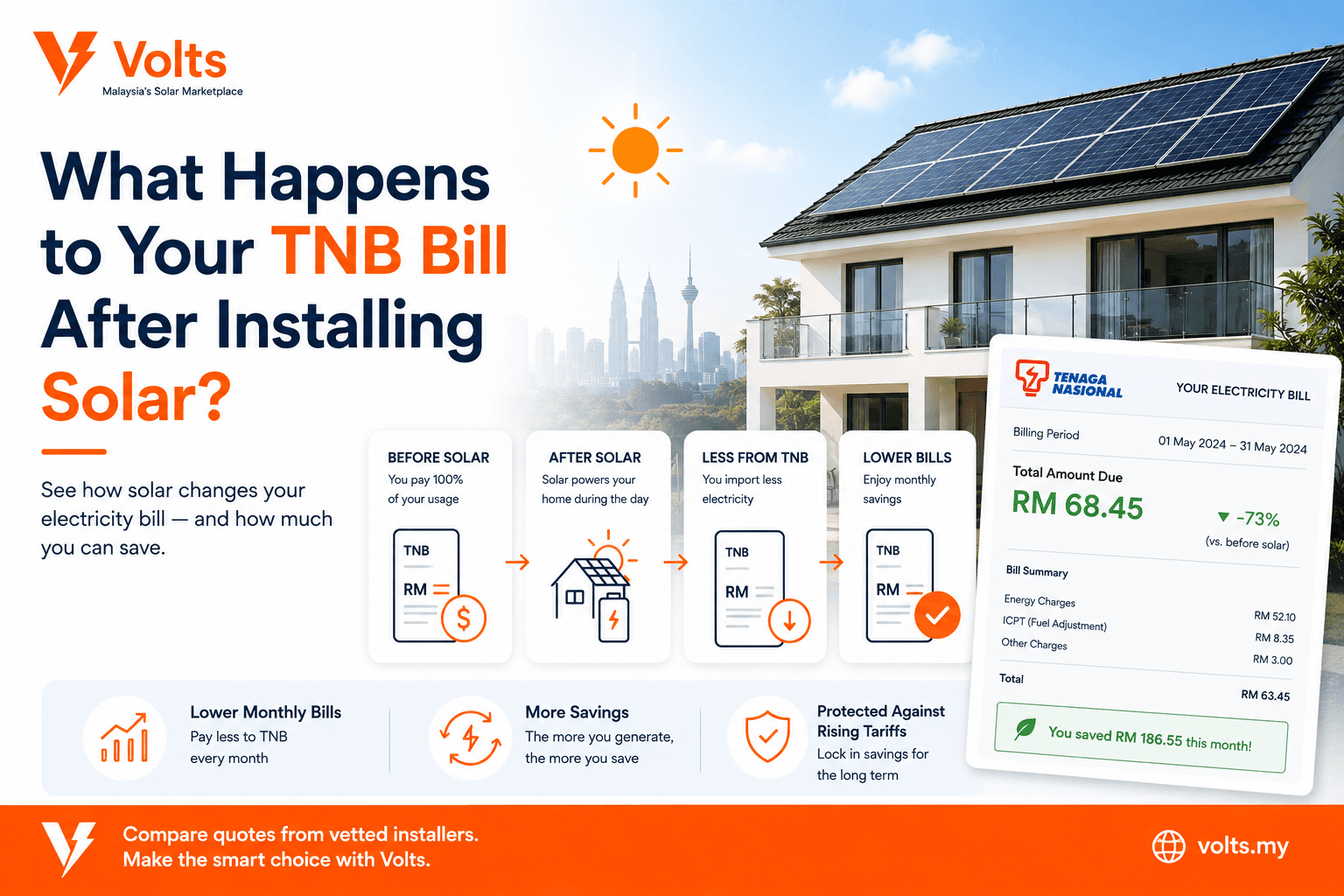
You waited weeks for TNB meter upgrade, the installer switched on your system, and your first bill arrives looking nothing like before. Some homeowners panic — "Why am I still paying TNB?" — while others are pleasantly surprised. Both reactions usually come from not knowing what to expect.
Key takeaway: After solar, your TNB bill becomes a net of import minus export credits, not a simple "solar replaces TNB" switch. Most homes still pay something monthly — especially in low-production monsoon months — but annual savings should align with your installer's projection if the system is performing.
This guide walks through how billing works post-switch-on. For programme rules and export rates, see our TNB net metering guide.
Before solar: how your bill is structured
A standard residential TNB bill includes:
- Energy charge — based on kWh consumed, tiered by usage block.
- ICPT surcharge (when applicable) — fuel cost adjustment.
- Renewable Energy Fund (RE fund) — small per-kWh levy.
- Network and service charges — fixed components on most domestic tariffs.
You import electricity from the grid. Your meter counts kWh in one direction only.
After solar: the bi-directional meter
TNB replaces your meter with a bi-directional (two-way) meter that records:
- Import (kWh in) — power you draw from TNB when solar is not enough.
- Export (kWh out) — surplus solar sent to the grid when production exceeds home demand.
Your bill is calculated on net energy under the net metering programme — export offsets import via bill credits at the applicable export rate.
You do not get a cash cheque for exported power. Credits reduce your bill until they are used or carried forward per programme rules.
Your first bill after switch-on: what to look for
The first post-solar bill often covers a partial month — some days without solar, some with. Expect it to look odd.
| Line item | What it means |
|---|---|
| Import kWh | Grid power used (night, rainy days, high load beyond solar) |
| Export kWh | Surplus solar sent to grid |
| Net kWh | Import minus export (may be positive or negative for the billing period) |
| Energy charge | Calculated on net billable kWh after credits applied |
| Minimum charge | TNB may still apply minimum monthly charges on some tariffs |
Do not judge the full financial picture from a single partial-month bill. Wait for 2–3 complete billing cycles.
Month-by-month: what normal looks like
Malaysia's solar output varies by season. Your bill will too.
Dry season months (Feb–Aug approx.)
- Strong midday production.
- Higher export if nobody is home during the day.
- Bills often drop sharply — RM 50–RM 150 for moderate users is common on a well-sized system.
- Some months may show very low or near-zero energy charges if export credits cover most import.
Monsoon / cloudy months (Oct–Jan approx.)
- Production drops 20–40% vs peak months.
- More reliance on grid import, especially for evening aircon.
- Bills rise compared to dry season — this is normal, not a fault.
- Homeowners who sized for annual average still save over the full year.
Hari Raya, Chinese New Year, school holidays
Usage spikes (more people home, more cooking, more aircon) can wipe out export even on sunny days. A RM 80 bill in March and RM 220 in December can both be normal on the same system.
Worked example: typical terrace household
Profile: 5 kW system, north-facing, RM 280/month average pre-solar bill, family of four, both parents office hours.
| Month | Solar production | Import | Export | Approx. bill |
|---|---|---|---|---|
| March (sunny) | 580 kWh | 320 kWh | 210 kWh | RM 95 |
| May (sunny) | 560 kWh | 340 kWh | 190 kWh | RM 110 |
| August (mixed) | 480 kWh | 380 kWh | 120 kWh | RM 145 |
| November (rainy) | 350 kWh | 450 kWh | 40 kWh | RM 210 |
| Annual average | ~5,800 kWh | ~4,200 kWh | ~1,600 kWh | ~RM 130/month |
Pre-solar average was RM 280. Post-solar average roughly RM 130 — about RM 1,800/year saved. Individual months vary; the annual figure is what matters for ROI.
Why you might still pay TNB every month
Solar rarely eliminates your bill entirely. Common reasons:
- Night-time consumption — no sun, full grid import for aircon and lighting.
- Fixed charges — minimum billing components exist on most accounts.
- Low-production months — monsoon clouds reduce output below your usage.
- Undersized system — system covers only part of your consumption by design.
- High evening loads — EV charging, oven, multiple aircons after 6 p.m.
A RM 100–RM 200 monthly bill post-solar on a previously RM 350+ account is often a good outcome, not a sign the system failed.
Export credits: what homeowners get wrong
Myth: "I exported 300 kWh so my bill should be zero."
Export earns credits at the export rate, which is lower than what you pay for import on the retail tariff. Exporting 300 kWh does not cancel 300 kWh of import ringgit-for-ringgit.
Myth: "Negative net kWh means TNB owes me cash."
Bill credits roll forward within programme rules — they reduce future bills. You do not receive payment unless specific programme terms allow it (uncommon for standard residential NEM).
Myth: "My installer said zero bill guaranteed."
No installer can guarantee zero bills. Usage, weather, and tariff changes all affect outcomes.
How to verify your system is performing
Compare installer projections to reality after 6–12 months:
- Check your monitoring app — monthly kWh produced.
- Compare same month year-on-year — March 2026 production vs March 2027.
- Benchmark: ~1,100–1,300 kWh per kW installed annually is a reasonable Peninsular Malaysia range for unshaded systems. A 5 kW system producing only 3,500 kWh/year warrants a service call.
- Review TNB bill import/export lines — rising import with flat production may mean a fault or higher household usage.
If production is 15%+ below projection for two consecutive months in dry season, contact your installer for a health check.
Billing issues and who to contact
| Problem | Who to contact |
|---|---|
| Meter not recording export | Installer first, then TNB if meter fault confirmed |
| Bill still shows old meter / no export line | TNB — meter upgrade may not be fully activated |
| Production normal but savings too low | Review usage habits; confirm system size matches expectations |
| App shows production but bill unchanged | Meter communication issue — installer inspection |
| Dispute on credit calculation | TNB customer service with bi-directional meter readings |
Keep your switch-on date, meter upgrade confirmation, and first three post-solar bills filed together. They are essential for any warranty or performance dispute.
Tips to lower post-solar bills further
- Shift loads to daytime where practical — washing machine, dishwasher, pool pump.
- Pre-cool the house before peak evening tariff periods if time-of-use ever applies.
- Right-size future upgrades — a second EV charger may need more panels, not just hope.
- Maintain panels — dust and debris after dry season can trim output 3–5%.
Bottom line
Your TNB bill after solar is a monthly snapshot of a year-round system. Low bills in sunny months and higher bills in rainy months are both normal. Judge performance on annual savings, not any single statement.
If you have not installed yet, model your expected usage and savings with the Volts calculator. If you are already live, give the system 12 months before deciding whether it met expectations — one cloudy November is not the full story.
Ready to see your numbers?
Get 3 free quotes from SEDA-verified installers — 100% free for homeowners.
Calculate My Savings